Artificial intelligence (AI) is changing the insurance industry in ways many customers never see. Behind the scenes, insurers are using AI to streamline claims processing, reduce paperwork, and improve the overall customer experience. In the UAE, this means faster claim assessments, quicker document verification, and more efficient communication throughout the claims journey.
While AI doesn’t replace human expertise or decision-making, it helps automate routine tasks so claims can often be processed more accurately and in less time. For policyholders, this can mean that the process changes into fewer delays, fewer repetitive information requests, and a smoother claims experience.
This guide explains how AI insurance claims processing works, where it is being used across motor and other general insurance products, and what UAE policyholders can expect as insurers continue to adopt AI-powered technologies.
What Is AI Insurance Claims Processing?
AI insurance claims processing means using software tool that can “learn” from data to:
- Read and extract information from claim documents
- Classify and route claims to the right teams
- Detect patterns that suggest fraud or errors
- Support adjusters in deciding how much to pay and when
Instead of humans doing every step manually, AI handles much of the intake, triage and checking, while humans focus on complex decisions, complaints, and exceptional cases.
How Does AI Claims Processing Work?
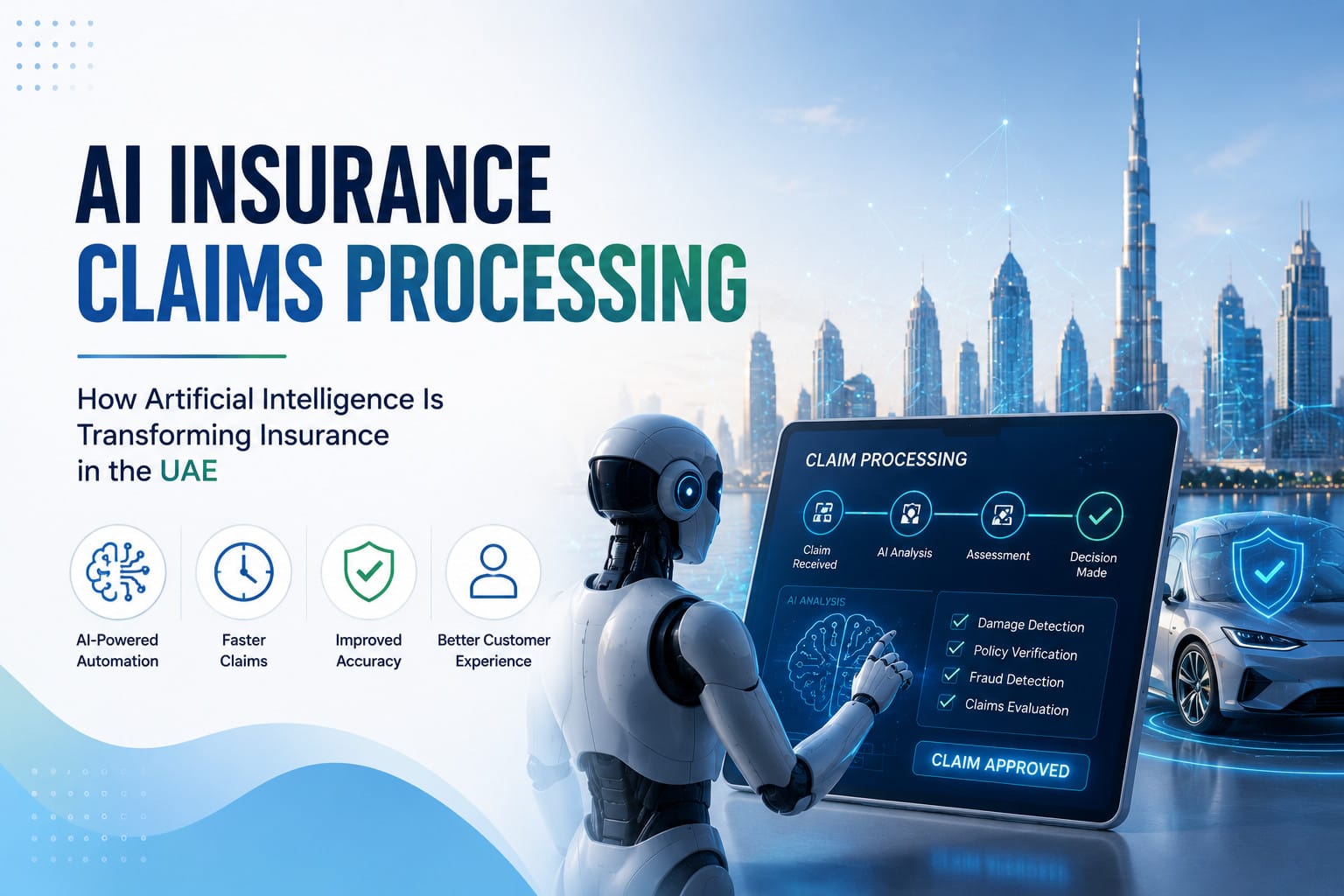
While each insurer’s system is different, most AI‑enabled claim journeys include:
1. Digital claim submission
Here the customer submits a claim via app/portal/email with photos, reports and invoices
2. Data extraction & validation
AI tools are used to read key information such as policy number, date, cause of loss, amounts. The system checks if the policy is active, coverage applies, and limits/excess are sufficient.
3. Triage & routing
In this case low‑value, straightforward claims may be marked as “fast‑track” and more complex or suspicious claims are flagged for human review.
4. Decision support
AI models compare the claim to past patterns to estimate fair repair cost or settlement ranges. If everything aligns, the handler can approve quickly; if not, they investigate further.
5. Automation of next steps
Automated communications channels such as SMS/email/app updates and also automatic payment instructions or repair authorizations for approved claims.
Benefits of AI Insurance Claims Processing for Policyholders
Here are a possible list of expectation a policyholder’s may set with regards what AI‑enabled claims should deliver:
- Faster turnaround – Simple claims can be approved significantly quicker because the system is “always on” and doesn’t get tired of repetitive checks.
- Fewer errors – Automated validation reduces the risk of missing documents, mis‑typed numbers or overlooked coverage limits.
- Better transparency – Digital journeys can show status updates such as “received”, “under review”, “approved”, “paid” in real time.
- More consistent decisions – For routine claims, using standardised rules and models reduces the risk of wildly different outcomes for similar situations.
- Improved fraud control – Detecting unusual patterns early protects honest customers by helping keep claims costs and therefore premiums under control.
How UAE Insurers Are Using AI in Claims Processing
Rather than replacing people, AI helps automate repetitive tasks so claims teams can focus on reviewing more complex cases and supporting customers when needed.
Digital-first platforms such as InsuranceMarket.ae are helping simplify the claims experience by making it easier for customers to submit documents, receive updates, and track the progress of their claims.
AI is particularly effective where:
- There is a high volume of similar claims e.g., motor own‑damage, minor property damage.
- Documents are standardised such as police reports, repair invoices, medical reports.
- Timely communication is critical through SMS/email/app notifications.
Typical uses include:
- Optical character recognition (OCR) and machine learning to read claim forms and invoices.
- Rule‑based engines and AI scoring to triage claims and assign them to the right team.
- Analytics on claim frequency and severity to spot outliers and possible fraud.
You may not always see “AI” labelled in your journey, you just notice that claims feel faster and smoother than a paper‑based process.
AI in Motor Insurance Claims: How It Works in the UAE
Motor insurance is often the first line of business where AI appears, because claim volumes are high and data is relatively structured vehicle details, repair codes, labour rates, etc.
Here are few examples of how AI can help in UAE motor claims:
- Automated checks that your policy is active and covers the reported loss type.
- Smart routing of your claim to a nearby approved garage based on your car type and location.
- Image‑based assessment support where photos of damage help estimate repair complexity or flag total‑loss potential, however, this is still usually confirmed by human surveyors.
- Text and email bots to keep you updated without long phone queues.
The principles of indemnity and fair claim handling remain; AI just makes the process more efficient.
Challenges and Limitations of AI in Insurance Claims
Despite the benefits of using AI, there are certain important limitations which requires Human Intervention:
1. Data quality
If documents are incomplete, poorly scanned or inconsistent, AI cannot “guess” missing facts reliably.
2. Context and empathy
A model cannot fully understand the emotional impact of a claim; humans are still essential for complaints, disputes and hard cases.
3. Bias and fairness
If historical data was biased, models trained on that data might repeat those patterns. Insurers must monitor and adjust models to keep decisions fair.
4. Customer trust
Some policyholders are uncomfortable with “black box” decisions; clear explanations and easy access to human help remain critical.
AI is a tool, not a replacement for sound underwriting, transparent communication and good customer service.
What AI Claims Processing Means for the Future of Insurance in the UAE
Looking ahead for the future of Insurance in the UAE, AI is likely to:
- Make simple claims almost instant in many cases.
- Increase the use of self‑service channels like apps, portals for both FNOL (first notice of loss) and status checks.
- Allow insurers and brokers to offer more tailored advice based on patterns in your claims and cover.
- Free up human claim handlers to focus on large, complex and sensitive cases.
For UAE consumers, this should translate into:
- Faster, more predictable claim experiences.
- Better alignment between premiums, risk and behaviour over time.
- More expectation that “digital first, human always available” is the standard.
Frequently Asked Questions
1. What is AI insurance claims processing?
2. Is AI used in UAE insurance claims?
3. Does AI claims processing mean no human involvement?
1. Settle complex or disputed cases.
2. Make judgement calls where the data is unclear.
3. Provide empathy and explanation when customers need it.
4. Will AI change how I submit a claim in the UAE?
5. Is AI‑based claims processing fair for policyholders?
1. The quality and neutrality of the data used to train models.
2. Ongoing monitoring and adjustments by insurers.
3. Clear channels for you to question or appeal decisions.
Reputable insurers treat AI as decision support, with humans still responsible for final outcomes and customer care.
Conclusion
AI insurance claims processing is already changing the experience of policyholders in the UAE often in subtle ways like faster approvals, fewer missing documents and clearer updates. For most customers, the best sign of success is that claims feel easier and less stressful than before.
As AI becomes more embedded in the market, UAE drivers and policyholders should expect:
- Quicker, more digital claims journeys.
- Continued human support for complex situations.
- A stronger link between accurate data, fair underwriting and smooth claim outcomes.
If you are unsure how your advisor uses AI in claims or what it means for your policy you can always ask for a simple explanation. The technology may be advanced, but your rights as a policyholder remain the same clear cover, fair handling and prompt, transparent communication.