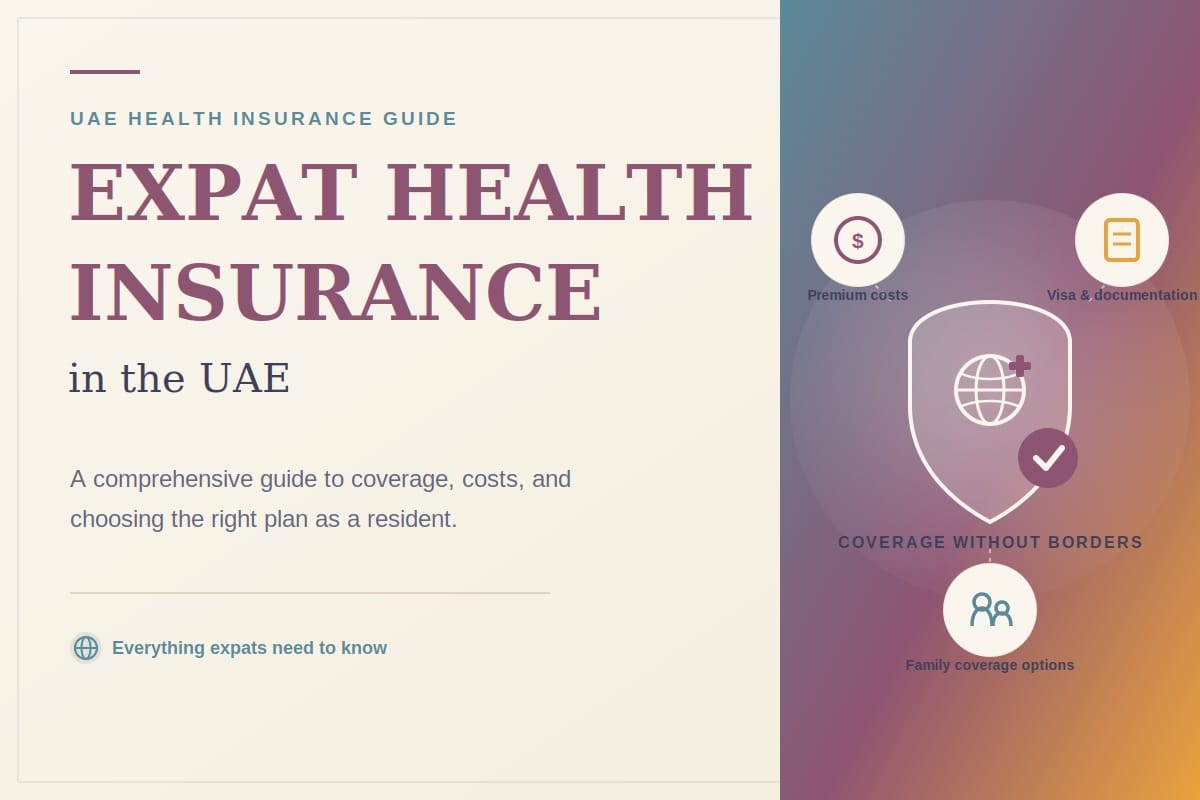
Moving to the UAE is exciting, but while adapting also means navigating a new healthcare system. Private healthcare is high quality, yet it can be expensive without the right cover. For expats, choosing health insurance for expats is as important as arranging your visa or accommodation.
This guide explains how health insurance for expats works in the UAE, what your policy may cover, how employer-sponsored and individual plans differ, and what you should consider before buying a policy or changing jobs.
Is Health Insurance Mandatory for Expats in the UAE?
Yes, in key emirates such as Dubai (DHA) and Abu Dhabi (DOH) health insurance is mandatory for all residents, including expats.
You must obtain a UAE residency visa with proof of health insurance. The requirements for health insurance coverage vary depending on the emirate:
- Abu Dhabi: Employers must provide health insurance coverage for their employees and four dependents, including one spouse and three children under 18.
- Dubai: Employers must provide medical insurance for their employees, but covering dependents is not mandatory.
- Sharjah and Northern Emirates: Employer-provided health insurance is not mandatory but may change as regulations evolve.
What Does Expat Health Insurance Typically Cover?
Coverage depends on the plan, but most expat policies include:
- Inpatient care which covers hospitalisation, surgery, ICU, room and board up to policy limits.
- Outpatient care includes general practitioner and specialist consultations, diagnostic tests, and prescribed medicines.
- Emergency treatment – Emergency room visits and ambulance services for serious conditions.
More comprehensive expat health insurance can also include:
- Maternity with waiting periods,
- Chronic condition management,
- Dental and optical benefits,
- Mental health services,
- Worldwide or regional cover for travel and relocation.
It is important to always check the benefit table as exact limits, co‑pays and exclusions vary widely.
Basic vs Comprehensive Health Insurance for Expats
| Feature | Basic / Essential Health Insurance | Comprehensive / Enhanced Health Insurance |
| Coverage Level | Meets the minimum legal health insurance requirements applicable in the emirate. | Provides broader protection with higher limits and more extensive benefits. |
| Hospital Network | Usually has a more limited network of healthcare providers. | Generally offers access to broader and potentially higher-tier hospital and clinic networks. |
| Annual Limits | Typically has lower annual coverage limits. | Usually offers higher annual limits for greater financial protection. |
| Outpatient Care | Focuses on essential outpatient treatment and basic consultations, depending on the plan. | Typically provides stronger outpatient benefits and wider access to specialists and diagnostics. |
| Additional Benefits | Primarily focused on essential medical needs. | May include maternity, chronic disease management, and optional dental or optical benefits, depending on the plan. |
| Cost | Generally the more affordable option. | Usually costs more due to broader coverage and higher limits. |
| Best Suited For | Lower-income workers, people who rarely need medical care, or those primarily seeking minimum required coverage. | Families with children, expats planning a baby, or professionals looking for more comprehensive protection. |
Employer Health Insurance vs Personal Health Insurance
| Feature | Employer Health Insurance | Personal / Individual Health Insurance |
| Who Pays? | The employer typically pays some or all of the premium, depending on the employment arrangement. | The individual pays the full premium. |
| Regulatory Compliance | Employer-sponsored plans are generally structured to meet applicable local health insurance requirements. | The individual selects a plan based on their own coverage needs and applicable requirements. |
| Plan Choice | Employees usually have limited control over the insurer, healthcare network, coverage limits, and benefits. | You can choose the insurer, network, coverage limits, and optional benefits that suit your needs. |
| Family Coverage | May cover the employee only, depending on the employer’s benefits package. | Can be structured to cover dependents, such as spouses and children, under a family plan. |
| Cost | Group pricing may make coverage more economical per person, with the employer potentially covering part or all of the cost. | You bear the full cost of the policy, although you have greater control over the level of cover you purchase. |
| Job Dependency | Coverage is generally linked to your employment and may end when you leave the company. | Coverage is not tied to a specific employer, subject to renewal and policy terms. |
| Pre-existing Conditions | Coverage depends on the terms of the employer’s group policy. | Underwriting may be stricter, and pre-existing conditions may be subject to specific terms, exclusions, or waiting periods. |
| Best Suited For | Employees who want employer-sponsored medical cover and are satisfied with the available benefits and network. | Expats who want greater control over their healthcare cover or need to insure family members independently. |
Many expats use a combination of both relying on employer-provided health insurance for themselves while purchasing personal or family health insurance for spouses, children, or other dependents, or choosing a top-up plan to address gaps in employer coverage.
8 Things Expats Should Check Before Buying Health Insurance
- Network hospitals and clinics – Are your preferred hospitals in‑network in your emirate(s)?
- Annual limits and sub‑limits – Overall annual limit per person; specific caps for maternity, physio, etc.
- Outpatient co‑pays – Percentage you pay for visits, tests and medicines.
- Maternity benefits (if relevant) – Waiting period, limits for normal and C‑section, and approved hospitals.
- Pre‑existing condition rules – Are existing illnesses covered and from when? Any waiting period or special caps?
- Geographical cover – UAE‑only, GCC‑wide, or worldwide and whether the USA is included or excluded?.
- Claims and approvals process – Is there an app or portal? How are reimbursements handled if you go out‑of‑network?
- Compliance with local rules – Does the plan clearly meet DHA/DOH and visa requirements for your emirate?
Getting clear, written answers to these questions will help you avoid the most common expat insurance problems.
What Happens to Your Health Insurance When You Change Jobs?
Here is what happens to your health insurance in case of job change:
For employer‑provided cover, typically:
- Your policy remains valid until your last working day or visa cancellation exact timing depends on the company and insurer.
- After that, the employer’s obligation to insure you stops.
- You must either join your new employer’s scheme, or arrange your own individual/family policy while your visa situation is updated.
Important tips for expats:
- Do not assume you are covered during your job‑search or notice period – ask HR for the exact last day of cover.
- Avoid any gap between old and new policies; going uninsured, even briefly, can be risky and may affect how new insurers treat conditions that arise during that period.
- If you are happy with your existing insurer, ask whether you can convert from group to individual continuation subject to rules and cost.
Frequently Asked Questions
Is health insurance mandatory for expats in the UAE?
Does my employer have to provide health insurance?
Do expats need health insurance for their dependents?
Can expats buy private health insurance in the UAE?
How much does health insurance cost for expats in the UAE?
Does health insurance cover pre-existing conditions?
What happens to my health insurance if I change jobs?
Find Health Insurance That Fits Your Life in the UAE
Expat life in the UAE can change quickly with new jobs, new emirates, new family members. Your health insurance for expats should evolve with you. The best policy is the one that:
- Meets legal requirements for your emirate,
- Covers your real risks and your family’s, and
- Works with the hospitals and clinics you actually use at a price you can sustain.
If you are unsure where to start, or you are changing jobs and worried about keeping continuous cover, we are here to help.
InsuranceMarket.ae helps UAE residents compare health insurance options from leading insurers, making it easier to review available plans and choose coverage that aligns with their healthcare needs and budget