Summary
For a hospital visit in the UAE, always carry your Emirates ID, health insurance card (or digital card), payment method, current list of medications, and key medical reports. Health insurance matters because it can significantly reduce your medical bills, especially if you use network hospitals in the UAE that support cashless treatment under your plan.
Introduction
A hospital visit in the UAE can be stressful – whether it is a planned check‑up, a sudden illness or an emergency. Having the right health insurance UAE‑wide and knowing what to bring can make the experience much smoother and protect you from surprise costs.
This guide provides a clear hospital-visit checklist for the UAE, explains how health insurance coverage works, and highlights common mistakes to avoid.
When Might You Need a Hospital Visit in the UAE?
You may need a hospital visit, UAE‑wide for:
- Planned consultations or check‑ups
- Diagnostic tests (blood tests, X‑rays, scans)
- Day‑care procedures or surgeries
- Maternity care and delivery
- Accidents and emergency treatment
In each of these situations, your insurance coverage, network and approvals will directly affect how much you pay and how fast you are treated.
Essential Hospital Visit Checklist in the UAE
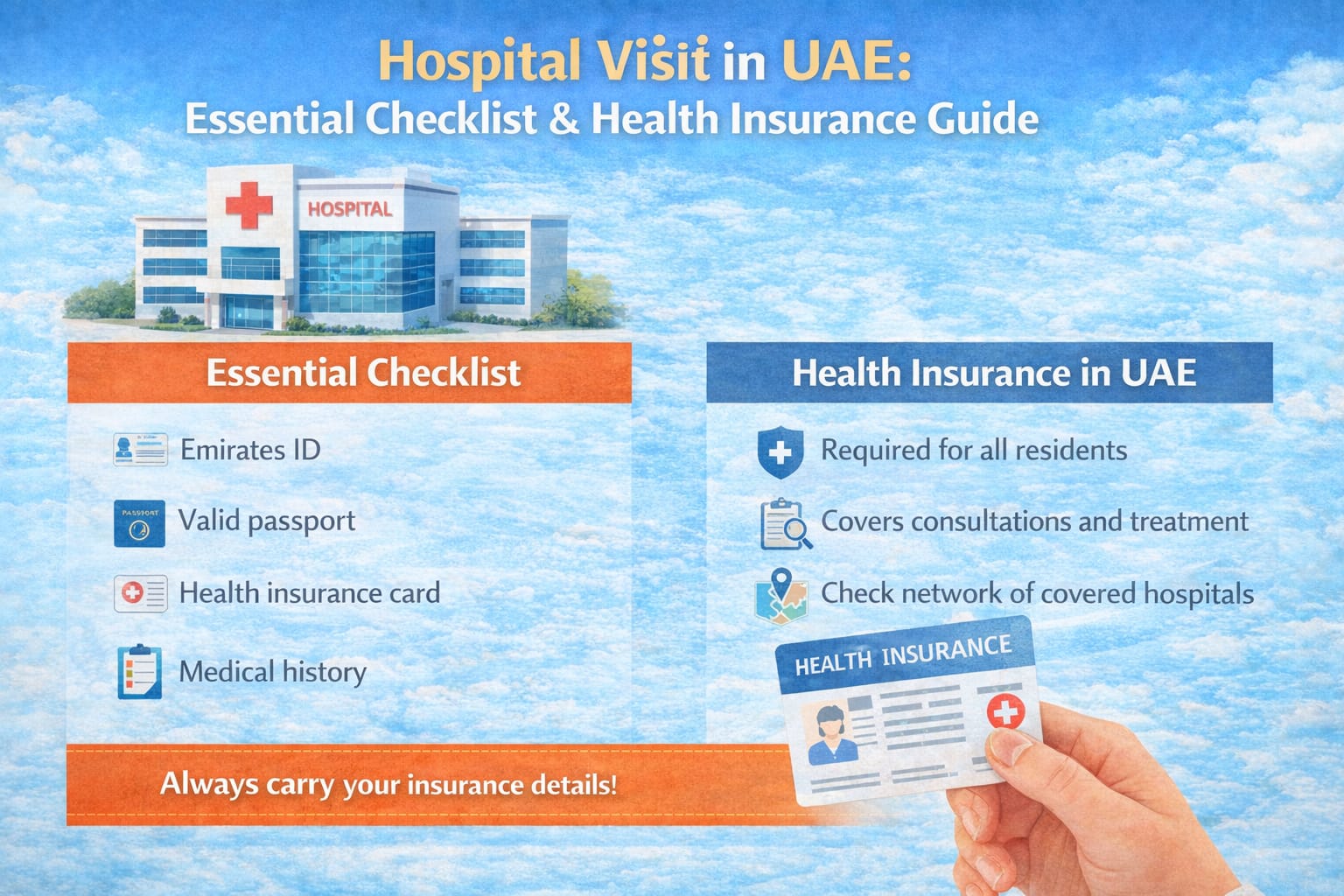
Here is a simple UAE hospital checklist you can follow for most visits:
Must‑bring items
- Emirates ID
- Health insurance card or digital e‑card
- Payment method (debit/credit card or cash for co‑pays)
Medical documents
- List of current medications and dosages
- Previous test results or reports related to your condition
- Referral letter (if your insurer or hospital requires it)
For planned admissions or surgery
- Hospital admission letter/booking confirmation
- Any pre‑approval (authorisation) letters from your insurer
- Contact details of a family member or emergency contact
For children
- Child’s Emirates ID and insurance card
- Vaccination card, if relevant
Having these ready reduces delays and helps hospitals and insurers process your visit efficiently.
Why Health Insurance Matters During Hospital Visits
Health insurance coverage UAE‑wide is crucial because:
- Medical care can be expensive; even simple tests and short stays add up quickly.
- Insurers negotiate prices with hospitals, often reducing your out‑of‑pocket costs.
- Cashless treatment at network hospitals means you usually pay only co‑pays and non‑covered items.
- Pre‑authorisations for larger procedures can ensure you know what is covered before treatment.
Without insurance, you may be asked to pay a deposit or full charges directly to the hospital.
What Does Health Insurance Typically Cover in the UAE?
Each policy is different, but most health insurance plans arranged through InsuraceMarket.ae include some combination of:
- Outpatient benefits such as Doctor consultations, Diagnostic tests, Prescribed medicines, etc. (up to plan limits)
- Inpatient benefits such as Hospital stay and surgery, Intensive care, if medically necessary, Theatre and nursing charges
- Emergency cover, such as treatment in the emergency department if your condition meets the policy’s definition of emergency
Coverage always depends on your plan’s network, annual limits in your policy, co‑payments and deductibles. There are also some specific exclusions (for example, some pre‑existing conditions or elective procedures)
Understanding Network Hospitals & Cashless Treatment
“Network hospitals UAE” are medical providers that have an agreement with your insurer. Using them usually means Cashless treatments, where the hospital bills your insurer directly for covered services. You only pay your share (co‑pay, deductible or non‑covered items). Better costs, which are agreed tariffs, can be lower than walk‑in self‑pay prices.
If you choose a non‑network hospital, you may need to pay the full amount yourself and claim reimbursement later (if your plan allows), or have no coverage at all for that visit, depending on your policy.
Before a planned hospital visit, always check if the hospital is in your network, and ask whether pre‑authorisation is required.
Common Mistakes to Avoid During a Hospital Visit
To protect both your health and your wallet, avoid these common mistakes:
- Forgetting your Emirates ID or insurance card can delay registration and insurance approval.
- Assuming all services are covered, some tests or procedures may be excluded or require co‑pays.
- Going to a non‑network hospital without checking because you might end up paying far more than expected.
- Skipping pre‑authorisation for planned procedures may result in your insurer reducing or refusing payment if the process is not followed.
- Not asking for a detailed bill, it is important to know what was charged and what your insurer has covered.
Tips for a Smooth Hospital Experience in the UAE
Use these simple tips to make your hospital visit smoother:
- Confirm network status in advance – Call the hospital or your insurer, or ask Alfred to check.
- Arrive early for planned visits – Allow time for registration and insurance verification.
- Keep all reports in one folder (physical or digital) – This helps doctors and speeds up approvals.
- Ask about costs before non‑emergency tests – Check if your plan covers them and what your share will be.
- Contact InsuranceMarket.ae with questions. If you are unsure what your plan covers, we can help you understand it or compare better options.
FAQs
What should I carry for a hospital visit in the UAE?
Is health insurance mandatory for hospital visits in the UAE?
Can I visit any hospital with my health insurance?
Can I visit any hospital with my health insurance?
What happens if I don’t have health insurance in the UAE?
Do UAE health insurance plans cover emergency visits?
Conclusion
A hospital visit in the UAE does not have to be chaotic or financially overwhelming. With a simple hospital visit checklist, awareness of network hospitals and a good understanding of your health insurance coverage UAE‑wide, you can focus on getting better instead of worrying about paperwork and bills.
If you are not confident in your current cover, or you want a plan that works better with your preferred hospitals, we can help. Call Instant Alfred to understand your options. We help you compare quotes in minutes and find the most economical health insurance for your needs.