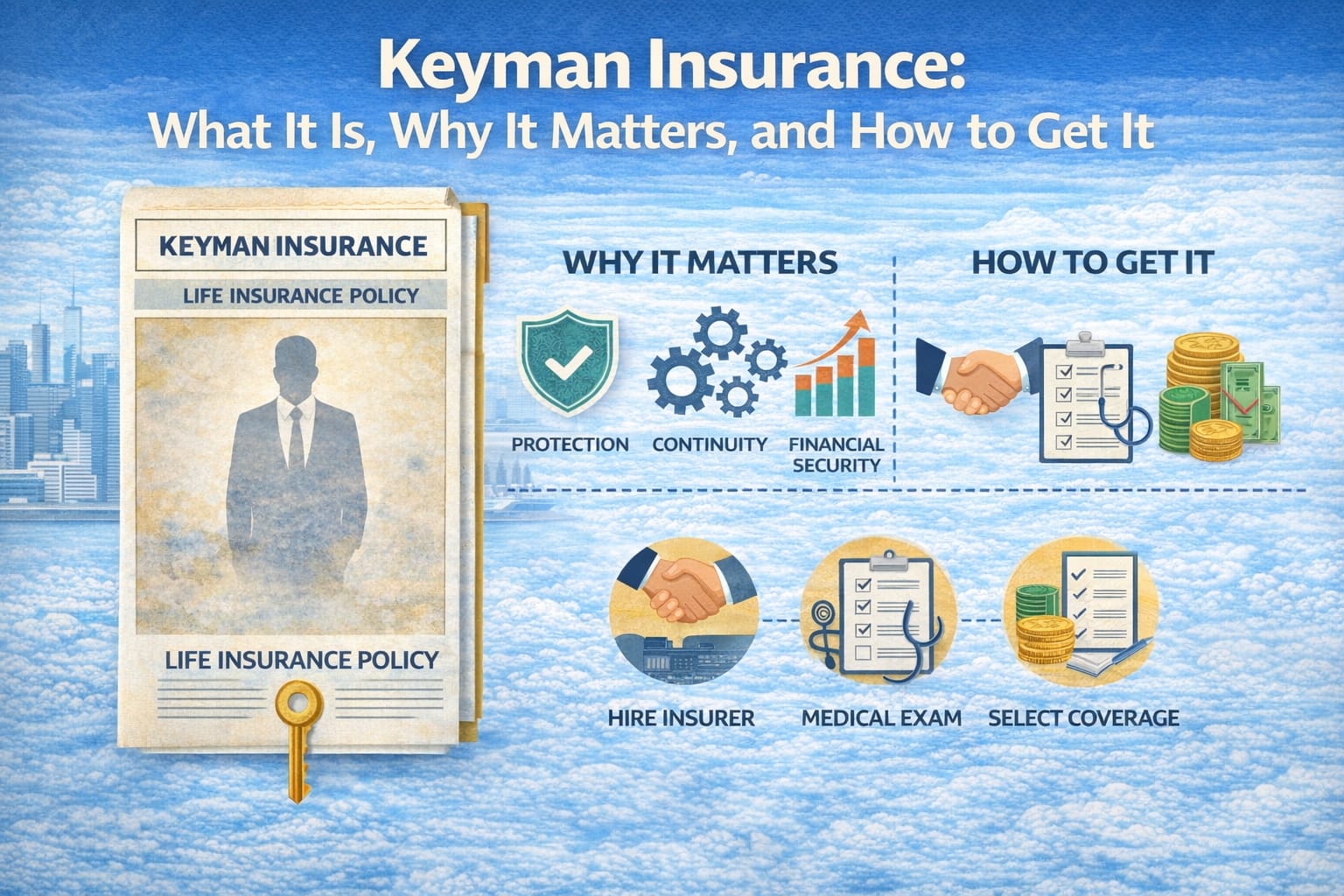
When a business depends heavily on a few key people, losing one of them can create serious financial pressure. Keyman Insurance is designed to protect the company when this happens. In the UAE and wider GCC, where many businesses rely on specialist talent and founders, this protection can be especially important.
In this guide, we explain what Keyman Insurance is, how it works, who it is for, and the main points to consider before you buy.
Answer Capsule: What Is Keyman Insurance?
Keyman Insurance is a life insurance policy that a business buys on the life of a crucial employee or owner. The company pays the premiums and is usually the policy beneficiary. If the key person dies (and sometimes if they suffer a serious covered illness), the payout helps the business cover costs such as lost profits, loan repayments, or the cost of recruiting a replacement.
What Is Keyman Insurance?
Keyman Insurance is a life insurance policy taken out by a business on the life of an important employee to protect the company against financial loss if that person dies. It is specifically designed to help businesses manage the financial impact of losing someone whose skills, relationships, or leadership are hard to replace.
In many cases, the policy can also be structured to provide benefits if the key person suffers a serious covered illness, depending on the chosen plan and options.
Who Is a Key Person in a Business?
A “key person” is anyone whose loss would significantly affect the company’s operations or financial stability. Typical examples include:
- Founders and co-founders who drive strategy and vision
- Senior executives or directors responsible for major decisions
- Top salespeople or relationship managers who bring in large portions of revenue
- Technical experts whose specialist skills are difficult to replace
- Business partners whose share or role would be hard to cover
The defining feature is not the person’s job title, but the level of financial and operational impact if they were no longer there.
How Keyman Insurance Works
Here is how Keyman Insurance generally operates:
- Business identifies the key person
The company assesses which individuals are critical to revenue, operations, or funding. - Policy is taken out on the key person’s life
The business applies for a life insurance policy on the key person. Medical and financial underwriting may apply, similar to regular life insurance. - The business pays the premiums
The company is responsible for premium payments. This is part of the cost of protecting the business. - The business is usually the beneficiary
You can name your business as a beneficiary, especially when you are purchasing Keyman Insurance or partnership protection. This allows the payout to flow directly to the company. - If the key person dies (or suffers a covered event)
The insurer pays the agreed sum assured to the business. This money can be used to cover costs such as recruitment, revenue loss, or business loans tied to the key employee. - The business uses the payout to stabilise operations
The funds help the company manage cash flow, maintain confidence with lenders and investors, and buy time to find a replacement or adjust the business model.
Why Keyman Insurance Is Important for Businesses
For many companies in the GCC, especially SMEs, the business is heavily dependent on a small number of individuals. Keyman Insurance helps with:
- Covering recruitment and training costs for a replacement
- Offsetting revenue loss during the transition period
- Supporting loan or credit obligations linked to the key person
- Maintaining investor and lender confidence at a difficult time
Small businesses can also benefit; smaller firms can use Keyman Insurance to safeguard against the financial shock of losing a key employee.
Keyman Insurance vs Personal Life Insurance
There is a clear line between the two:
- Keyman Insurance focuses on protecting the business from financial losses if a key employee dies or suffers a covered serious event. The business normally owns the policy and receives the payout.
- Personal life insurance is designed to protect family and personal financial goals, such as children’s education or paying off a home loan. The individual (or their family) owns the policy, and the beneficiaries are usually family members.
The purpose, ownership, and beneficiaries are therefore very different.
Types of Keyman Insurance Policies
Life insurance can be structured in different ways, mainly:
- Term Insurance
Coverage for a fixed period aligned to the premium payment term (for example, 10, 20 or 30 years etc. based on the requirement). It is usually more economical and straightforward for pure protection needs. Many Keyman policies are set up using term insurance. - Whole of Life Insurance (WOL)
Coverage that can last for the insured’s entire life and also accumulates cash value over the long term, often with additional features and potentially higher premiums. In some situations, businesses may consider longer-term structures, but this is less common for simple key person risk.
In addition, Keyman cover can sometimes be combined with riders such as:
- Critical illness cover, so the business receives a payout if the key person is diagnosed with a covered serious illness.
- Total permanent disability cover, depending on product design.
The exact options depend on the insurer and product, but they will be based on these basic life insurance forms.
How Much Keyman Insurance Coverage Is Needed?
It does not prescribe a single formula, but in practice, businesses often consider:
- The key person’s direct contribution to revenue or profit
- Financial loss in case of eventuality
- Any business loans or guarantees linked to that individual
- The expected time needed for the business to recover
Because needs vary, it is sensible to look at your financial exposure and then choose a sum assured that would meaningfully reduce the risk if the key person is no longer able to work.
You can reach to advisors at InsuranceMarket.ae to help you estimate an appropriate level based on your business situation.
Advantages of Keyman Insurance
Main advantages include:
- Financial support to manage Business Continuity
- A buffer against short-term revenue loss
- Help in servicing business loans or obligations tied to the key person
- Greater confidence for investors, lenders, and partners
- Can be suited to small and large businesses alike
Limitations and Key Considerations
Here is the general guideline
- Tax treatment is not guaranteed
Tax benefits vary by jurisdiction, so it is best to consult a qualified financial or tax adviser for specifics. Do not assume premiums or payouts will automatically be tax-deductible. - Coverage is limited to defined events
The policy only pays out if the covered events (such as death or specific critical illnesses) occur during the policy term, in line with policy conditions and exclusions. - Premiums must be maintained
If premiums are not paid, coverage may lapse, depending on the product opted for, leaving the business unprotected. - It does not replace good succession planning
Keyman insurance mitigates financial loss and does not replace succession planning
Frequently Asked Questions (FAQs)
Is Keyman Insurance mandatory?
Who owns the policy?
Can the employee be the beneficiary?
What happens if the employee leaves the company?
The policy can be transferred to the individual and the company stops being the policy owner.
You should review the policy terms and speak with your adviser about options if a covered key person leaves.
Steps to Buy Keyman Insurance
Identify your key people and business risks
List the individuals whose loss would seriously disrupt revenue, operations, or loan arrangements.
Estimate the financial impact
Consider recruitment costs, expected revenue loss, and outstanding loans tied to each key person.
Decide on the type and level of cover
With Alfred’s help, choose between term-based protection and any additional riders (such as critical illness) and select an appropriate sum assured.
Provide information for underwriting
The key person may need to complete health questionnaires and possibly undergo medical tests, depending on the cover amount and the insurer’s requirements.
Review terms and exclusions carefully
Use Alfred’s guidance and FAQs on benefits, exclusions, and definitions to understand what is and is not covered.
Activate and regularly review the policy
Once in force, review your Keyman Insurance whenever your business grows, takes new loans, or changes key roles.
How Alfred Can Help
Understand whether Keyman Insurance is suitable for your business
Compare life insurance structures and benefits
Choose an economical solution that matches your risk and budget
Call Instant Alfred to understand your options, or let Alfred help you compare quotes in minutes and find the most economical option for your business.