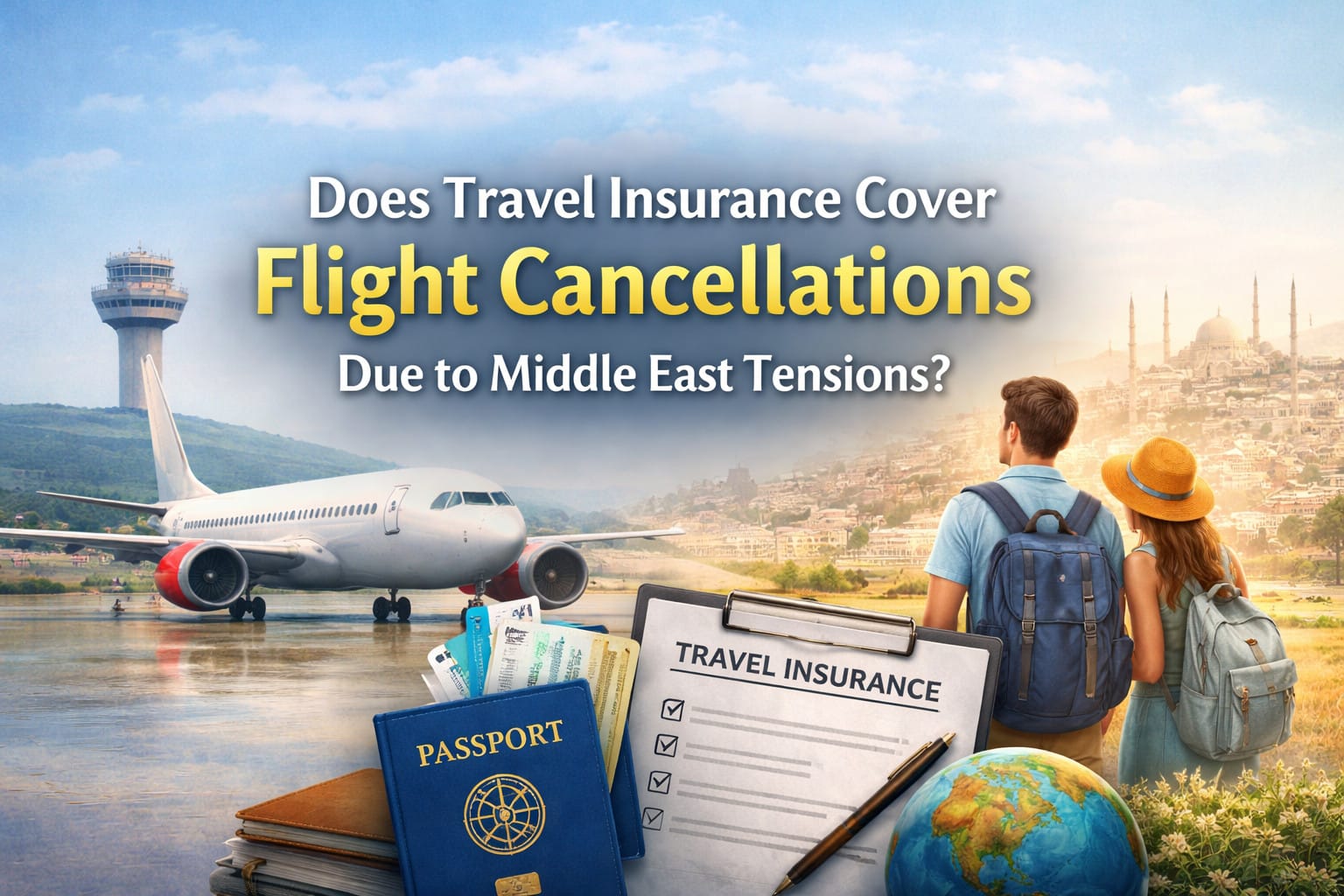
Tensions and unrest in parts of the Middle East can create understandable anxiety for travelers. Flight cancellations, airport closures, and last‑minute schedule changes are all possible when the security situation changes quickly.
Where does that leave you if your flight is cancelled or disrupted due to conflict or security concerns in the region? Will your travel insurance help or are these situations excluded?
This guide walks you through how travel insurance in UAE typically works in these scenarios, what’s usually covered or excluded, and the practical steps you should take if your plans are affected.
Understanding Travel Insurance and Flight Cancellation Coverage
Most comprehensive travel insurance policies include some form of trip cancellation, trip interruption, and travel delay benefits. These are designed to reimburse you for non‑refundable prepaid costs if you cannot travel or must cut your trip short due to specific, listed reasons (often called “covered reasons”).
Typical covered reasons for cancellation/interruption may include:
- Serious illness, injury, or death of you or a close family member
- Major damage to your home before travel (e.g., fire, flood)
- Certain strikes or severe weather events
- Court summons or jury duty
- Other unexpected events clearly listed in the policy wording
However, not all causes of flight cancellation are treated equally. When the interruption is related to war, POLITICAL unrest or terrorism, many policies apply very specific exclusions and conditions.
How Middle East Tensions Can Affect Flights
Security tensions in the Middle East can impact travel in several ways:
- Airspace closures or restrictions
- Flight cancellations or major schedule changes by airlines
- Airport closures or heightened security checks, causing delays
- Government travel advisories warning against or restricting travel to certain destinations
In many cases, the airline will be the first to cancel, rerouting or rescheduling flights based on safety assessments and regulatory requirements.
From an insurance perspective, what matters is why your trip is interrupted and how your policy defines and treats that cause (war, civil commotion, terrorism, government order, natural catastrophe, etc.).
When Travel Insurance May Cover Flight Cancellations
There are scenarios where your travel insurance in the UAE may provide some protection, even if the disruption is indirectly linked to regional tensions. Common examples:
1. Government or Airline Actions Leading to a Covered Event
If a government or airline decision (e.g., closure of airspace or airport) results in:
- Significant delay (often a minimum number of hours, such as 6, 12, or 24), or
- You missing a connecting flight, or
- The trip being cut short once you’ve already started travelling
then trip interruption or travel delay benefits might apply, depending on your policy wording.
These benefits may reimburse:
- Additional accommodation and meal expenses (up to policy limits)
- Reasonable transport costs required to continue your journey or return home
- The unused, non‑refundable portion of your trip if you must abandon it
2. Terrorism Coverage with a Specific Extension
Some policies allow you to add a terrorism extension. For example, terrorism‑related claims are only covered if a specific terrorism extension has been added, and even then the cover may be limited to emergency medical and associated expenses.
In setups like that, a terrorism extension might help if:
- You suffer a covered medical emergency directly caused by an insured terrorism event, and
- The policy explicitly states that terrorism is covered (usually under medical / emergency expenses only).
However, even with such an extension, trip cancellation due solely to fear of travel or general instability is typically not covered unless it meets a clearly defined insured event.
2. Secondary Effects that Trigger Standard Benefits
Sometimes, tensions can cause knock‑on effects that do fall under standard benefits:
- You incur extra hotel nights and meals because your return flight is significantly delayed
- You have to buy a new ticket via an alternative route to get back home
- Your journey is interrupted and you lose prepaid, non‑refundable bookings
In such cases, travel delay or interruption sections of your policy may respond, provided the underlying cause isn’t excluded (e.g., an excluded war risk).
Situations Where Travel Insurance in Dubai, UAE Usually Does Not Cover
Most travel insurance plans have very clear war and terrorism exclusions. In the exclusions you shared, for example:
- War, invasion, revolution, civil unrest, rebellion, acts of a foreign enemy or similar events are not covered.
- Claims related to terrorism are only covered if a specific terrorism extension has been added, and then typically only for certain sections (like emergency medical).
- Natural disasters are excluded in most policies.
Based on typical wordings, here are common situations that are usually not covered:
- War and Civil Unrest
Claims that result directly or indirectly from war, invasion, revolution, civil commotion or similar events are commonly excluded. That means if your flight is cancelled due to an actual war or declared armed conflict, your policy may not cover trip cancellation or interruption. - General Fear or Change of Mind
If you decide not to travel because you are worried about potential instability (even if the news looks concerning), that is generally classified as “disinclination to travel” and is not covered under standard benefits. - Known or Foreseeable Events at Time of Purchase
If major unrest, armed conflict or official travel bans were already in place before you bought the policy, insurers can argue that the event was known or foreseeable, and deny claims related to it. - Areas Specifically Excluded by the Policy
Some policies may list certain countries or regions as excluded territories due to ongoing conflicts or sanctions. Any travel to those areas may not be covered at all.
Always check the section of your policy that deals with general exclusions, war and terrorism, and natural disasters – this is where the limitations on Middle East tension‑related claims will be clearly described.
What Airlines May Offer Instead
When flight cancellations or disruptions are caused by security concerns or government decisions, airlines typically have their own obligations and options, such as:
- Rebooking you on the next available flight on the same or another route
- Offering a full or partial refund of the unused ticket value
- Providing meal vouchers, hotel accommodation or ground transport in some cases (this depends on the airline’s policies and applicable regulations)
From the insurance perspective:
- If the airline has already refunded you, you generally cannot claim the same amount again from your insurer.
- Travel insurance is usually designed to cover what you cannot recover from any other source (airline, hotel, tour operator, etc.).
So, if your airline offers a full refund or free rebooking, you may not have a valid claim under trip cancellation, because you haven’t suffered a financial loss.
Steps to Take if Your Flight Is Cancelled Due to Conflict
If your flight is cancelled or heavily disrupted due to tensions or conflict in the Middle East, follow these steps:
- Contact the Airline First
- Ask if they can rebook you on another flight or route.
- Clarify whether you’re entitled to a refund, vouchers, or accommodation.
- Collect Written Confirmation
- Request written confirmation (email, app notification, or document) stating the reason for cancellation.
- Keep all booking confirmations, new tickets and receipts.
- Review Your Policy Wording
- Check the sections on trip cancellation, interruption, travel delay, war, terrorism, and general exclusions.
- Confirm whether your situation fits within a covered reason or an exclusion.
- Contact Your Insurer or Broker
- Describe what happened and share the airline’s response.
- Ask clearly: “Based on my policy, do I have a claim for any non‑refundable expenses or additional costs?”
- Submit a Claim with Supporting Documents
- Include airline confirmation, receipts for hotels, meals, and new tickets, plus proof of non‑refundable bookings (e.g. hotels or tours you couldn’t use).
- Provide any documents your insurer specifically requests.
- Check What You Can Recover Elsewhere
- Some hotels or tour operators have flexible change or cancellation policies in these situations.
- If they refund you directly, you usually can’t claim that amount again on insurance.
Tips for Travelers Visiting the Middle East
If you’re planning to travel to or via the Middle East, consider the following:
- Buy insurance early and review the war/terrorism and natural disaster exclusions before you purchase.
- Monitor official travel advisories from your government for your destination.
- Keep your embassy or consulate contact details handy when travelling.
- Register your trip when possible with your embassy’s travel registration system.
- Always keep digital and printed copies of your policy, insurer contact numbers, and important travel documents.
- Build some flexibility into your itinerary: allow time buffers, and consider refundable options for high‑value bookings where possible.
Final Thoughts
Flight cancellations and disruptions linked to tensions in the Middle East sit at a complex intersection of airline policies, government decisions, and insurance exclusions. Standard travel insurance often provides limited protection in cases of war or terrorism The safest approach is to:
- Study your policy’s war/terrorism and trip cancellation sections before you buy,
- Ask direct questions of your insurer or InsuranceMarket.ae about your planned destination, and
- Treat travel insurance as part of a broader risk‑management plan that includes flexible bookings, monitoring advisories, and staying informed.
1. Does travel insurance cover war or terrorism?
Most standard travel policies exclude claims that directly or indirectly result from war, invasion, revolution, civil unrest, or similar events. In some products, any claim arising from war or similar events is explicitly excluded.
Terrorism may be treated differently:
Some policies exclude terrorism entirely.
Others allow you to add a terrorism extension, but even then it may only apply to emergency medical and related expenses, not to trip cancellation or interruption.
Always read the war and terrorism exclusions carefully, and if needed, ask your provider to explain how they apply to your destination.
2. What if my flight is rerouted instead of cancelled?
The airline will usually aim to get you to your original destination via an alternative route.
You may experience delays or extra travel time, but if you still complete the journey, trip cancellation benefits usually do not apply.
However, depending on your policy and the length of the delay, you may be able to claim under travel delay benefits for:
Extra meals and refreshments
Additional accommodation if an overnight stay becomes necessary
The key is the minimum delay threshold and whether the underlying cause is excluded (e.g., war vs. ordinary operational issues).
3. Can I claim compensation for hotel bookings?
Why you couldn’t use the hotel booking
If your trip was cancelled or interrupted for a covered reason, you can usually claim for non‑refundable prepaid accommodation.
If the cause is excluded (e.g., war), or if you simply decided not to travel out of concern, standard cancellation cover may not apply.
What the hotel or booking platform offers
If the hotel or agency refunds you in full, you cannot claim that amount again from your insurer.
Insurance is designed to cover only your actual financial loss after other refunds or credits.
Keep all booking confirmations and any correspondence showing whether the hotel refused or granted a refund.
4. What happens if the airline offers a refund?
You typically cannot claim the refunded amount under your travel insurance, because you have already recovered that cost.
You may still have a claim for other non‑refundable associated expenses (such as hotels, tours, or transfers) if the cancellation meets a covered reason and is not excluded.
If the airline offers only partial refunds or credits, then you may be able to claim the non‑refunded portion under your policy, subject to terms and exclusions.