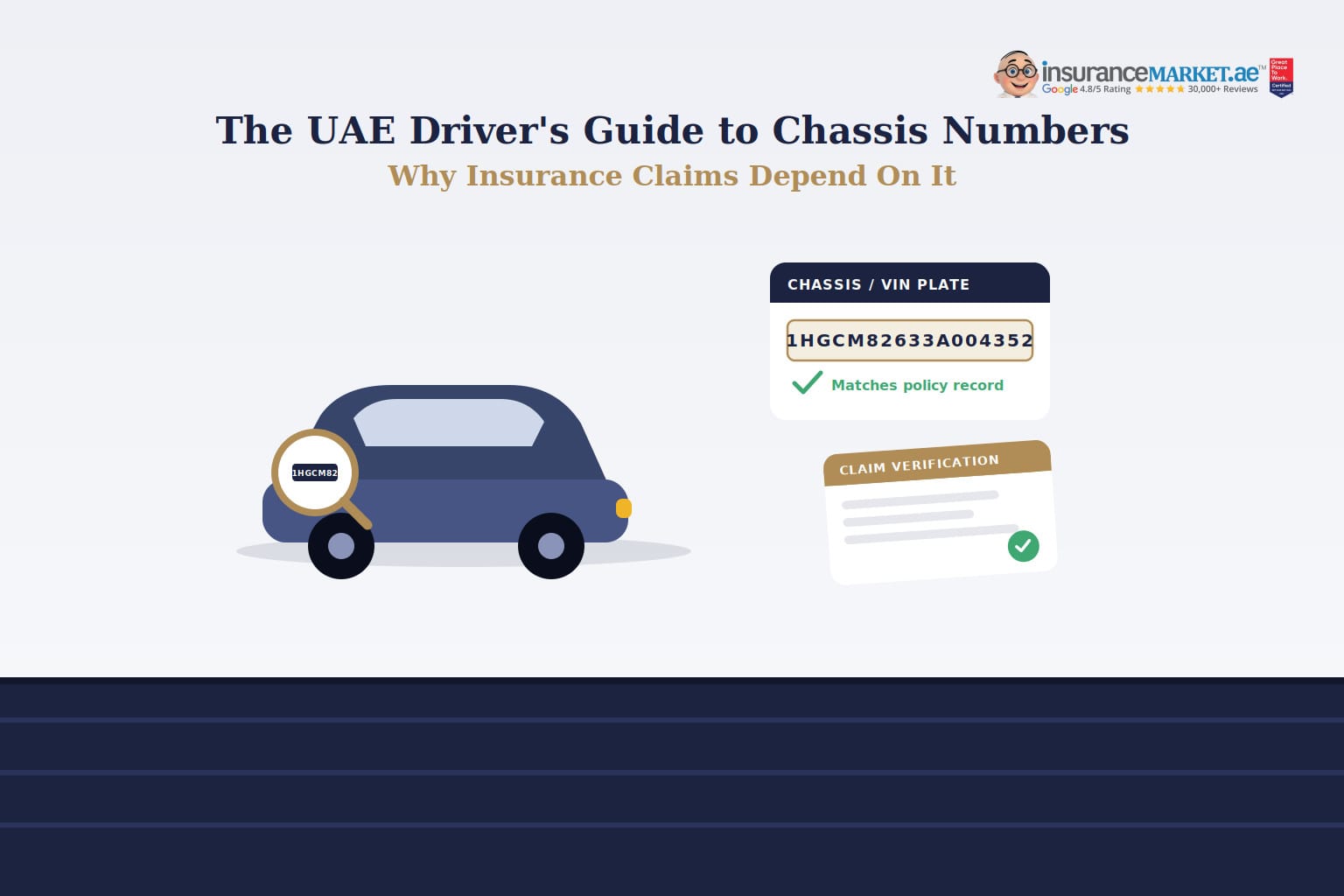
When choosing car insurance in the UAE, most drivers focus on the premium, coverage, and add-ons. But there’s another detail that can be just as important when it comes time to make a claim: your chassis number, also known as the Vehicle Identification Number (VIN). This unique number identifies your vehicle and is used across your registration, car insurance, and other official records. If it’s incorrect or doesn’t match across documents, it could lead to claim delays, additional verification, or complications with your insurer.
Here’s what every UAE driver should know about their chassis number and why it matters for car insurance.
Where to Find Your Chassis Number
You can usually find your chassis number in three places:
| Location | Where to Find It | Key Information |
| On the Car Itself | • Stamped into the chassis in the engine bay • On a metal plate or sticker on the driver’s side door pillar or door sill • Sometimes at the base of the windscreen, visible from outside | Locations vary by brand. Always reference a fixed, factory-stamped location when double-checking. |
| UAE Registration Card (Mulkiya) | Vehicle details section of the Mulkiya | The chassis number is a key reference for traffic authorities, insurance companies, accident centres, and inspection centres. |
| Purchase & Insurance Documents | • Dealer purchase invoice / sales contract • Insurance policy schedule and e-card | When filling online forms or updating policies, copy the VIN from an official document or a clear photo to reduce the risk of typos. |
Why Insurance Claims Heavily Depend on the Chassis Number
Insurers in the UAE rely on the chassis number to uniquely identify your vehicle and match your car to the following details
- Registration records (RTA / traffic department)
- Your policy schedule
- Any past car insurance claims or total‑loss records
If the VIN or Chassis number on your car, Mulkiya and policy don’t align, the insurer cannot be sure if they are insuring the correct car, if it is being repaired or written off is actually the one covered
This can lead to:
- Delays while they investigate the discrepancy
- Requests for extra documents or inspections
- In serious cases e.g. suspected fraud, cloned vehicles, claim rejection
Accurate chassis information is a core part of “utmost good faith” in insurance, both sides must be transparent and correct about what is being insured.
How to Check Your Chassis Number & Accident History in the UAE
Step 1: Check Consistency of the VIN
Do a quick three‑way comparison:
- VIN on the car body (engine bay / door pillar)
- VIN on the Mulkiya
- VIN on your insurance policy schedule
They should match exactly character by character.
Step 2: Use Official Channels to Check Accident / Total-Loss History
If you are buying or insuring a pre‑owned car, you can use official UAE traffic authority / government portals or apps varies by emirate to check the vehicle’s accident history using the chassis number, or plate and registration details
These services can reveal past major accidents, total‑loss / write‑off records, odometer or structural red flags where available
If what you see there doesn’t match what the seller claims e.g. “never crashed”, “single owner”, etc., treat it as a warning sign and ask more questions before buying or insuring.
What to Do If You Spot a Chassis Number Discrepancy
If any two sources don’t match, act immediately:
1. Rule Out Simple Typos
Common transcription mistakes:
- 0 vs O
- 1 vs I vs L
- Misplaced characters
If it’s clearly a typo on the policy, send your insurer or broker a photo/scan of Mulkiya and the physical VIN plate. Ask them to issue a policy endorsement correcting the VIN.
2. Incorrect Mulkiya
If the VIN on your car body doesn’t match what’s on the Mulkiya, visit the relevant emirate’s traffic department / RTA. Bring the car, Mulkiya and any supporting documents they can investigate and correct registration records if it’s an administrative error.
3. Red Flags for Pre-Owned Purchases
If you’re considering buying a used car and the VIN on the car body and Mulkiya don’t match, or there are signs of tampering around the VIN plate, treat this as a serious red flag. Possibilities include incorrect registration, chassis swap / rebuild and fraud or cloned vehicle
Do not proceed with payment or policy issuance until an official clarification is obtained.
FAQs
1. Can my car insurance claim be rejected if there is a typo in my chassis number?
2. How do I check if a pre-owned car has a total-loss history using its chassis number?
3. Is the chassis number the same as the engine number on my UAE registration card?
4. What should I do if the chassis number on my car’s body doesn’t match the Mulkiya?
1. Insurance coverage doubts
2. Registration or passing issues
3. Potential problems if you have an accident and need to claim
Conclusion
For UAE drivers, learning how to check chassis number accuracy is a small effort with big benefits:
- It keeps your registration clean.
- It makes buying and renewing car insurance smoother.
- Most importantly, it prevents avoidable complications or disputes when you need to make car insurance claims.
Before your next renewal, new purchase or policy change, take two minutes with advisors at InsuranceMarket.ae to confirm that the VIN on the car, Mulkiya and policy match perfectly. If they don’t, fix it now, not after an accident, when the stak