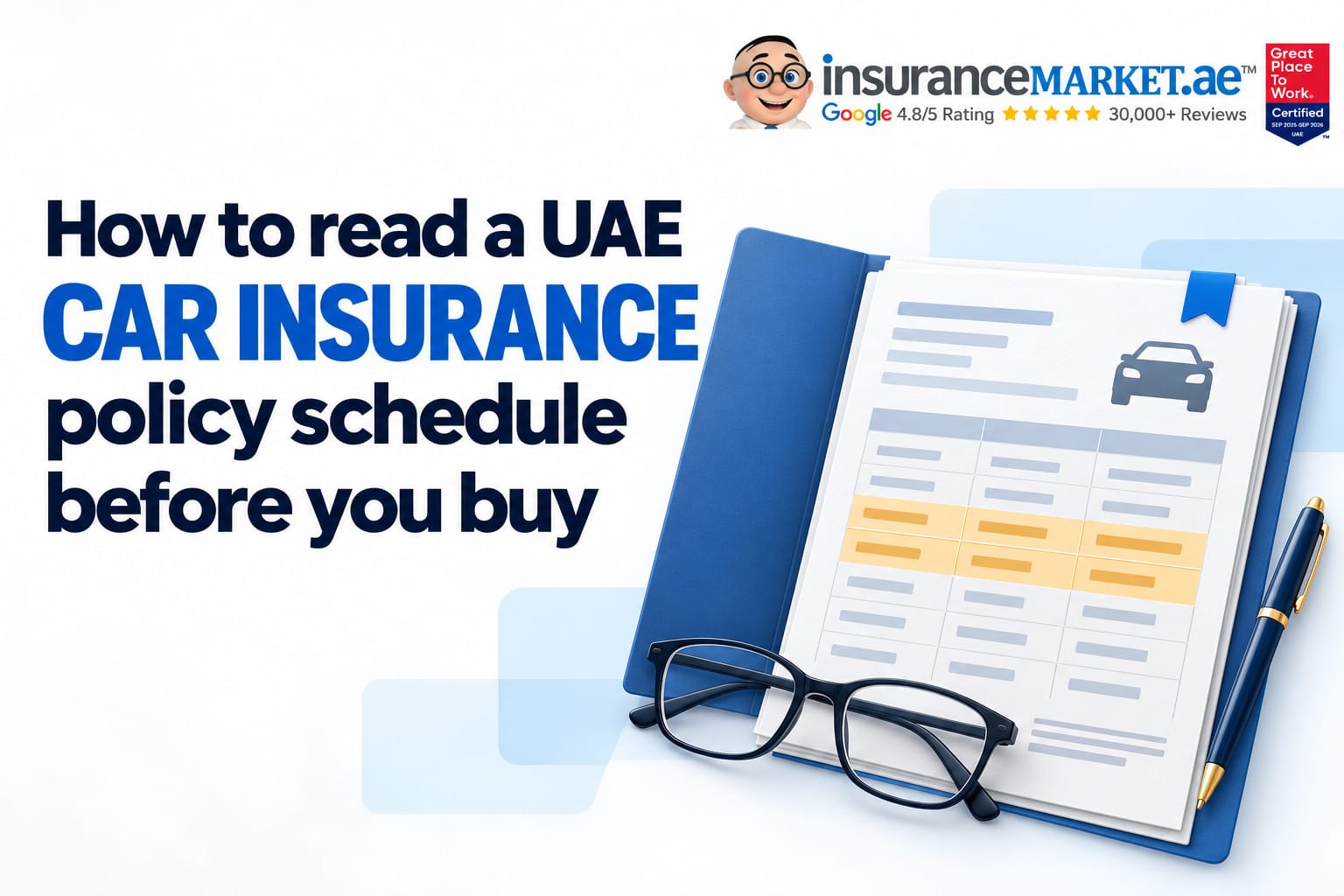
When buying car insurance in the UAE, it’s important to understand exactly what your policy covers. While the benefits and premium may influence your decision, your car insurance policy schedule provides the key details of your coverage, including the insured value, excess, repair options, and additional benefits.
Reviewing this document before purchasing your policy can help you avoid unexpected costs and confusion when making a claim.
In this guide, we’ll explain how to read a UAE car insurance policy schedule, what details to look for, and why each section matters.
What Is a Car Insurance Policy Schedule?
A car insurance policy schedule is a personalised document that outlines the key details of your insurance coverage. It forms part of your insurance policy and works alongside the policy wording, which explains the full terms, conditions, and exclusions.
Your policy schedule typically includes:
- Policyholder and vehicle details
- Type of car insurance coverage
- Insured vehicle value
- Excess and deductibles
- Repair options
- Included benefits and coverage limits
- Driver conditions and no-claims discounts
- Special conditions or endorsements
Think of your policy schedule as a summary of your coverage, while the policy wording explains how that coverage works.
10 Important Things to Check in Your Car Insurance Policy Schedule
1. Policyholder and Vehicle Details
Start by confirming:
- Your full name and Emirates ID/passport number
- Contact details
- Vehicle make, model, year and variant
- Chassis/VIN and registration plate
- Usage type (private, business, etc.)
Any mistake here can create issues later, so ask for corrections immediately.
2. Identify the Type of Car Insurance Cover
In the UAE, schedules will usually state whether your car insurance policy is:
- Comprehensive – covers your car plus third-party liability
- Third-party only – covers damage you cause to others, not your own car
Make sure the type of cover matches what you requested and what you paid for.
3. Vehicle Value or Sum Insured
Your car insurance policy schedule will mention the insured value or sum insured of your vehicle. This is generally determined based on factors such as your car’s market value, age, make, model, and condition.
Depending on the insurer and policy, the insured value may be based on an agreed value or market value.
Before purchasing your policy, check whether the amount shown reasonably reflects your vehicle’s value. If it seems too high or too low, ask your insurance provider or adviser for clarification.
4. Read Every Excess and Deductible
The excess, also known as a deductible, is the amount you may need to pay towards a claim before your insurer covers the remaining eligible costs.
For example, if your policy has an excess of AED 500 and your approved repair costs are AED 3,000, you would generally pay AED 500, while your insurer covers the remaining AED 2,500, subject to the policy terms.
When reviewing your schedule, check for:
- Standard accident excess
- Additional excess for young or inexperienced drivers
- Special excess for off-road driving, floods, or other specified situations
- Windscreen or glass excess, if applicable
A higher excess may reduce your insurance premium, but it can also mean paying more out of pocket when making a claim. Make sure you’re comfortable with the amount before purchasing your policy.
5. Repairs: Agency or Non‑Agency
Your car insurance Dubai schedule should clearly state the repair type:
- Agency repair – your car is repaired at the official dealer or authorised agency, this is usually only for newer cars or as an add‑on.
- Non‑agency repair – repairs are carried out at approved garages in the insurer’s network.
Check the wording carefully and do not assume comprehensive cover always includes agency repair. If having your car fixed at the dealer is important to you, ensure “agency” or equivalent wording is clearly shown on the schedule.
6. Review the Included Benefits and Their Limits
Car insurance policies may include additional benefits beyond standard coverage. These vary depending on the insurer and plan, so it’s important to review what’s included in your policy schedule.
Some common benefits include:
- Personal accident cover for the driver and passengers
- Emergency medical expenses
- Roadside assistance and vehicle recovery
- Replacement car or rental car benefits
- Natural perils cover, including certain flood and storm-related damage
- Off-road coverage for eligible vehicles
- Windscreen damage protection
Each benefit may have its own coverage limit, such as a maximum amount in AED or a specific number of days.
Check these limits carefully and confirm whether the benefits are included in your policy or require an additional premium.
7. Look for Named‑Driver and Driver‑Age Conditions
Some policies are any-driver, while others are named‑driver only or have age restrictions.
On your schedule, check:
- Whether all regular drivers are named, if required
- Any minimum-age or maximum-age limits
- Extra excesses for young or newly licensed drivers
If someone else regularly drives your car, confirm they are properly included under the car insurance policy conditions.
8. Check the No‑Claims Discount Information
If you have a history of claim‑free years, your schedule may show a no‑claims discount (NCD) level, such as a percentage or class/step.
- Make sure the NCD shown matches what you were told.
- If you are transferring from another insurer, confirm that proof of your previous NCD has been accepted.
Understanding how your NCD works will help you know what happens to your premium if you claim during the year.
9. Check Endorsements Attached to the Policy
Endorsements are special additions or changes to the standard policy wording. They might:
- Add extra benefits
- Change an exclusion
- Add a special condition for example, tracking device required, special parking requirement, or business-use limitation
These endorsements are sometimes listed on the last page of the schedule or on separate pages referenced by code. Always read them, as they can significantly change your cover.
10. Note the Dates, Territory and Use
Finally, confirm:
- Policy start and end dates
- Geographical limits , such as UAE only or extended GCC
- Permitted use e.g. private, commuting, business, etc.
Driving outside the allowed territory or using the car for a different purpose than stated may affect claims.
Conclusion – Why Your Schedule Deserves a Careful Read
Your car insurance policy schedule contains important details about your coverage, from the insured value and excess to repair options, additional benefits, and special conditions.
Taking a few minutes to review these details before purchasing your policy can help you understand what you’re covered for and avoid unexpected surprises when making a claim.
Need help choosing the right car insurance? InsuranceMarket.ae makes it easy to compare quotes from different insurers, review coverage options, and find a policy that suits your needs and budget.