Introduction
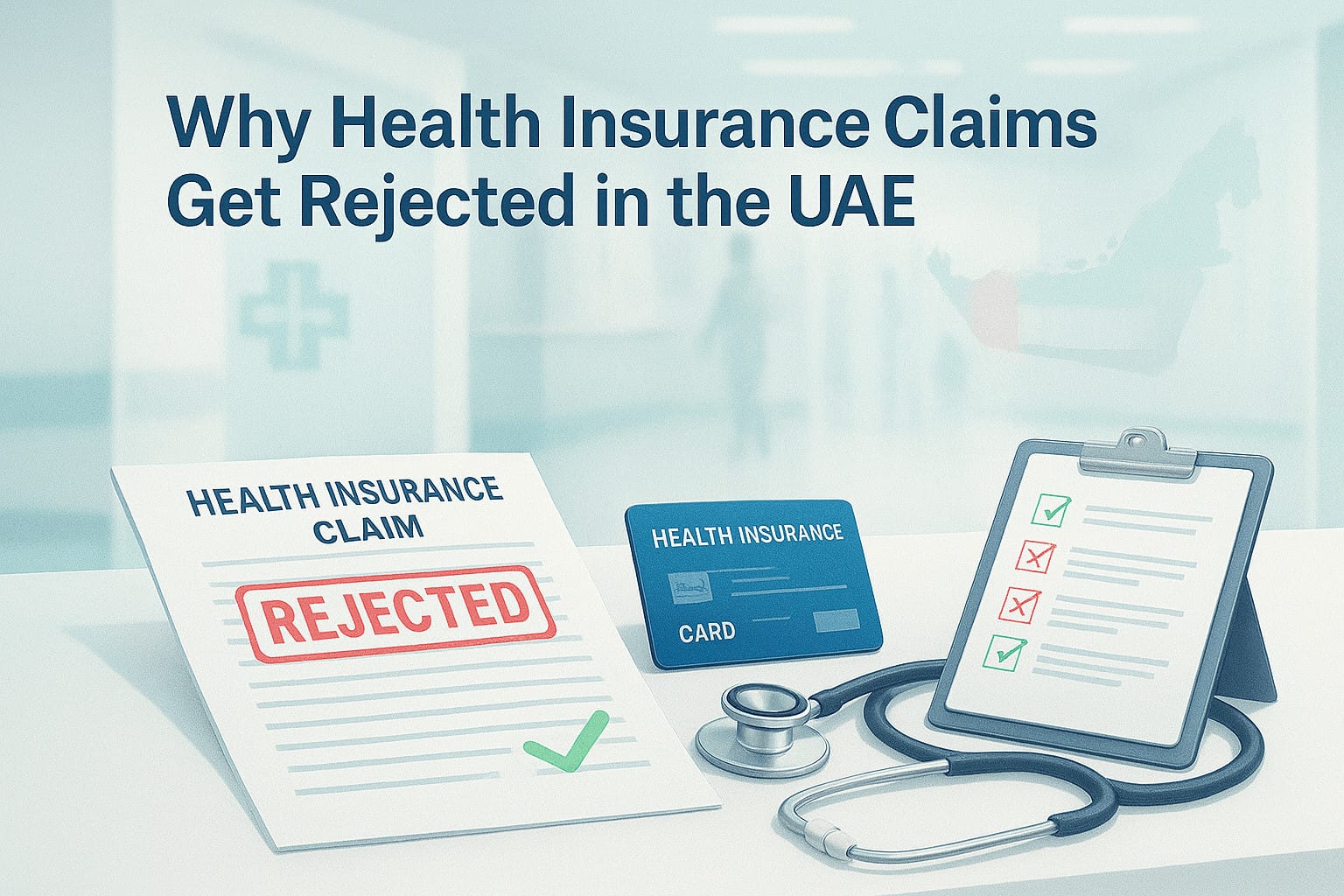
A hospital visit is stressful enough. Getting a message later that your health insurance claim has been rejected or only partly paid can feel overwhelming. In many cases, the problem is not bad faith by the insurer, but confusion about how cover, networks and approvals work in the UAE.
This guide explains how health insurance claims work, the most common causes of health insurance claim rejection in the UAE, and what you can do to prevent and fix issues.
How Health Insurance Claims Work in the UAE
In most UAE health insurance policies, claims are settled in two main ways, which are:
| Cashless / Direct Billing | Reimbursement |
| You visit an in-network hospital or clinic. | You pay the full medical bill yourself, often when using an out-of-network provider or receiving treatment overseas. |
| The hospital or clinic contacts the insurer or TPA for approval, where required. | You submit a health insurance claim along with invoices, receipts, and medical reports. |
| The insurer pays the eligible expenses directly to the healthcare provider. | The insurer reviews the claim and reimburses eligible expenses according to the policy terms and limits. |
| You only pay any applicable co-pays, deductibles, or non-covered expenses. | You initially bear the full cost of treatment and receive reimbursement later if the claim is approved. |
In both cases, the insurer always checks the following points:
- Is this treatment covered under the policy?
- Is the provider in the allowed network?
- Are limits, waiting periods and pre‑approvals respected?
If the answer to any of these is “no”, a rejection or partial approval can follow.
Common Reasons Health Insurance Claims Get Rejected
The most common reasons for a claim being partially approved or rejected include:
- The treatment is excluded from your policy – The service, medication, or condition falls under the policy’s exclusions. Common examples include purely cosmetic procedures, non-prescribed supplements, or treatments that are specifically excluded from coverage.
- Pre-existing conditions are not fully covered – The claim relates to a medical condition that is still within a waiting period or has been permanently excluded under the policy terms.
- Out-of-network treatment – You received treatment at a hospital or clinic outside your insurer’s approved network, and your plan does not offer reimbursement for non-network providers, except in genuine emergencies.
- Missing or incomplete documentation – This is particularly common with reimbursement claims. Missing original invoices, official receipts, medical reports, or diagnosis documents can delay or prevent claim approval.
- Incorrect member or policy information – Errors in names, identification details, or policy numbers can result in the claim not matching the insurer’s records.
- Late submission of reimbursement claims – Most insurers have strict claim submission deadlines. Claims submitted after the allowed period (for example, 30, 60, or 90 days after treatment) may be declined.
- No pre-authorisation obtained – Certain treatments, major procedures, expensive diagnostic tests, or specialised therapies may require insurer approval before treatment begins. If pre-authorisation is not obtained when required, the claim may not be fully covered.
- Annual limits or sub-limits have been reached – Your overall annual coverage limit or a specific benefit limit, such as maternity, physiotherapy, or specialist treatment, has already been exhausted for the policy year.
Understanding these common reasons can help you avoid claim issues and improve the chances of receiving full reimbursement when you need to use your health insurance.
Health Insurance Claim Rejection vs Claim Partial Approval
A claim can be either fully rejected or partially approved.
A full rejection means the insurer does not pay anything towards the claim. This typically happens when the treatment, service, or expense is excluded from the policy, not covered under the plan, or does not meet the eligibility requirements.
A partial approval means the insurer pays a portion of the claim, while you are responsible for the remaining amount. This can happen for several reasons, including: Co‑pays and deductibles, Charges above your policy’s maximum tariff, Some items (e.g. high‑end room upgrade, non‑covered drugs) being disallowed.
A partial approval is not necessarily an error; it may simply reflect your policy design.
How to Avoid Health Insurance Claim Rejections
You cannot control everything, but you can greatly reduce the risk of rejection by following these steps:
- Know your coverage and exclusions – Always read your policy’s benefits and exclusions sections. For any important treatment (e.g. maternity, chronic care), get clarity in advance.
- Use network providers where possible – Check if the hospital/clinic is in your plan’s network before non‑emergency visits. For emergencies, go to the nearest safe provider, then clarify your coverage as soon as you can.
- Get pre‑authorisation when required: for planned surgeries, expensive scans, or certain therapies, make sure your doctor or hospital requests approval from your insurer.
- Keep proper documentation: for reimbursement, always ask for detailed invoices and official receipts; additionally, keep all prescriptions and medical reports.
- Submit reimbursement claims on time – Check your policy’s deadline and send all documents well before it expires.
- Update your details – Ensure your insurer has the correct spellings, Emirates ID, and contact details to avoid mismatches.
- Ask questions before any treatment
- “Is this covered in my plan?”
- “What is my estimated co‑pay?”
- “Does this need pre‑approval?”
What to Do If Your Health Insurance Claim Is Rejected
If you face a rejected health insurance claim, you still have options:
- Request a clear written explanation – Ask the insurer or TPA for a rejection letter that explains the exact reason and policy clause.
- Check whether it is a documentation issue – If something is missing invoice, report, correct IDs, provide the needed documents and ask them to reassess.
- Compare the decision with your policy wording – See if the reason matches an actual exclusion, waiting period or limit.
- Escalate within the insurer – If you still don’t understand the claim process, use their formal complaints channel for a second review.
- Seek external help if needed – Regulators or health authorities may have formal dispute channels; you can also ask an expert advisor from InsuranceMarket.ae to help you understand whether an appeal is realistic.
Key Questions to Ask Before Receiving Treatment
To reduce surprises later, ask your provider and/or insurer:
- Is this provider in my network?
- Is this treatment covered under my plan?
- Do I need pre‑authorisation for this service?
- What will my co‑pay or deductible be?
- Will any part of this bill likely be non‑covered?
Write down the answers or keep emails so you have a record if a dispute arises.
Why Understanding Your Health Insurance Policy Matters
Many of the health insurance claim rejections in the UAE come from simple misunderstandings:
- Assuming any hospital is covered,
- Not realising a treatment is excluded,
- Missing pre‑approval rules, or
- Forgetting claim deadlines.
Spending a little time now to understand your network, your limits, your exclusions, and your claim process can save you from big financial and emotional stress later. InsuranceMarket.ae can help you review your policy in simple English, so you know exactly where you stand.
FAQs
Why was my health insurance claim rejected in the UAE?
The treatment or condition is excluded under your policy,
You used an out‑of‑network provider without reimbursement rights,
The claim related to a pre‑existing condition still under a waiting period,
Missing or incorrect documentation, or
The claim was submitted after the allowed time.
Can I appeal a rejected health insurance claim?
Ask for a written explanation
Provide any missing documents or clarification
Use the insurer’s formal complaint or appeal channel, and
In some cases, escalate further through local regulators or health authorities.
Will health insurance cover treatment at any hospital in the UAE?
What documents are required for a reimbursement claim?
Completed claim form,
Copy of your insurance card and ID,
Original invoices and receipts,
Doctor’s consultation notes and diagnosis,
Prescriptions and pharmacy receipts, and
Any pre‑authorisation or referral letters if needed.
Always check your insurer’s specific list before submitting.
Do pre-existing conditions affect claim approval?
What happens if I exceed my health insurance limit?
Conclusion
Most health insurance claim rejections in the UAE can be traced back to coverage misunderstandings, network issues, missing approvals, or documentation problems. With some preparation and by asking the right questions in advance, you can greatly reduce your chances of facing rejection and know how to respond if it still happens.
If you have had a claim refused, or you simply want a clearer, more “claim‑friendly” policy, we can help you review and compare your options.
Contact InsuranceMarket.ae to understand your options. Our health insurance advisors help you compare health insurance plans in minutes and find the most economical cover with clear, predictable claims in the UAE.