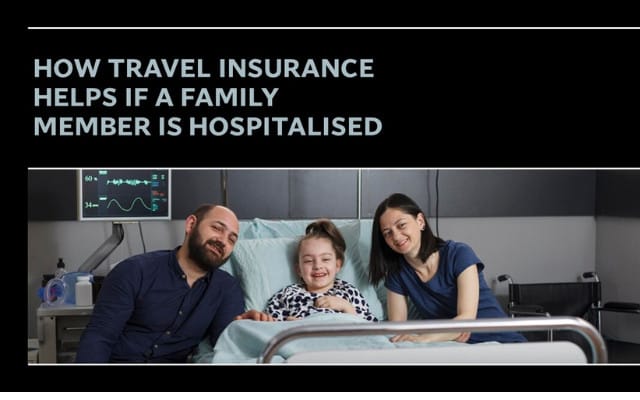
A family medical emergency is stressful enough at home—let alone when it happens during an international trip. Whether a loved one falls ill abroad or a close relative is suddenly hospitalised back home while you are travelling, travel health insurance can play a crucial role in reducing both financial and logistical stress.
For UAE residents and visitors in 2026, this guide explains how travel insurance plans typically respond when a family member is hospitalised, what’s usually covered, what isn’t, and how to prepare before you travel.
Does Travel Insurance Cover Family Hospitalisation?
Here are two different scenarios where Travel insurance can protect you:
- A family member travelling with you is hospitalised abroad
Your policy may cover their emergency medical treatment and hospitalisation, possible evacuation or repatriation and certain related travel costs, depending on the plan
- A close family member at home is hospitalised while you are abroad
Your policy may cover trip curtailment so you can return home, unused, non‑refundable trip costs, e.g., prepaid hotel nights, tours
However, not all UAE travel insurance policies include the same family‑related benefits. Each insurer defines “family”, “hospitalisation” and “covered reasons” differently. You should always check your schedule and policy wording to see which family emergencies are insured events under your plan.
Who Counts as “Family” Under UAE Travel Insurance?
Travel insurers usually give a specific mention of “family member” or “relative” in the policy wording. This matters because family‑related benefits apply only to people who meet that definition.
Depending on the policy, “family” may include spouse or legal partner, children, parents, siblings and also Grandparents or grandchildren in some policies
Important points to consider:
- Some policies are stricter, limiting “family” to spouses and dependent children only.
- Others are broader, including parents, in‑laws and siblings for curtailment benefits.
- For family members travelling with you, they usually need to be named on the policy (or covered under a family/group policy) for their medical costs to be claimable.
Before you rely on family‑related cover, confirm exactly who counts as “family” in your policy.
What Does Travel Insurance Cover When a Family Member Is Hospitalised Abroad?
When a family member who is insured under the same policy is hospitalised while travelling, travel health insurance can typically help in several ways:
1. Emergency Medical Treatment and Hospitalisation
If a covered family member gets seriously ill or injured abroad, your policy can generally pay for emergency consultations and diagnostics, inpatient hospital stays and surgery, medication and related emergency treatment. Limits apply per person and per trip
This is the core of travel health insurance for all insured travellers on the policy.
2. Emergency Medical Evacuation and Repatriation
If the treating doctors and the insurer’s medical team agree that the patient needs to be moved to another facility, or they should be transported back to their home country for treatment,
The policy may cover air ambulance or medical escort costs, as well as medically necessary repatriation to their home country. This usually only applies to insured family members named under the policy.
3. Companion Expenses (on Some Plans)
Some travel insurance plans may contribute towards additional accommodation and travel costs for one companion to stay with the hospitalised insured family member, or Costs for a close relative to fly out and accompany the patient home, if medically justified and pre‑approved.
These benefits are not automatic and often have strict limits e.g., economy fairs, capped hotel nights and require prior authorisation from the insurer’s assistance centre
4. Trip Curtailment (Cutting the Trip Short)
If a very serious hospitalisation occurs to either an insured family member travelling with you or a close family member back home (depending on your policy wording), your policy may treat this as a covered curtailment event. That could mean reimbursement of unused, non‑refundable prepaid costs and additional reasonable travel costs to return home sooner than planned
You will typically need medical evidence and confirmation that the event meets the policy’s definition of a valid curtailment reason.
What Is NOT Covered Under UAE Travel Insurance for Family Hospitalisation?
While cover can be generous in true emergencies, travel insurance has clear limits and exclusions.
Common things that are not covered or are tightly restricted include:
- Non‑emergency or routine treatment – Check‑ups, chronic condition reviews, or elective procedures and planned treatments abroad, even for insured family members
- Undeclared or excluded pre‑existing conditions – If a serious hospitalisation abroad is due to a known condition that the policy excludes, the claim may be rejected or reduced. Some plans allow pre‑existing conditions by special agreement; many don’t.
- Hospitalisation of non‑defined family members – If the person affected doesn’t meet the policy’s definition of “family”, you may not be able to claim under family‑related benefits (like curtailment).
- Hospitalisation of someone with no direct relationship to your trip – Distant relatives or friends who become ill at home may not qualify as a valid curtailment reason.
- Events not meeting the policy’s severity threshold – Minor illnesses or brief admissions that do not meet the definition of “serious medical condition” or “hospitalisation” as required by the policy.
- Costs that go beyond policy limits or outside the area of cover – If treatment is more expensive than your medical limit, or if the hospitalisation occurs in a country not in your area of cover.
Always read: “What is covered” sections for medical, curtailment, and companion benefits and the Exclusions chapter, especially for existing conditions, age limits, and non‑emergency care
How to Claim Travel Insurance for Family Hospitalisation: Step-by-Step
If a family medical emergency occurs during your trip, acting promptly and methodically helps both your health outcomes and your claims.
Step 1: Get Immediate Medical Help
- Take the family member to the nearest suitable hospital or clinic.
- In life‑threatening situations, use local emergency services first—paperwork comes later.
Step 2: Contact the Insurer’s 24/7 Assistance Line
As soon as it’s safe to do so, call the assistance number on your policy:
- Tell them who is hospitalised, what happened, and where they are.
- Give them your policy number and contact details.
- Ask if they can issue a payment guarantee to the hospital (see FAQ below).
Many insurers prefer or require pre‑authorisation for non‑urgent admissions, further tests, or transfers.
Step 3: Keep All Documents
Collect and keep admission and discharge summaries, medical and diagnostic reports, itemised invoices and receipts, proof of payments and, for curtailment, evidence of unused pre‑paid bookings (hotel confirmations, tickets). All these are crucial for your travel insurance claims.
Step 4: Follow the Insurer’s Instructions
The assistance centre may ask for periodic updates from the treating doctor, organise medical evacuation or repatriation if appropriate, and advise you on which costs are covered directly and which you might need to pay and claim back later.
The key tip is to avoid managing expensive medical transport on your own without approval, unless it’s a genuine life‑or‑death emergency and there is no time to contact them.
Step 5: Submit a Formal Claim After the Event
Once the situation stabilises, complete the insurer’s claim form, attach all supporting documents, such as medical reports, invoices, booking confirmations, unused tickets, etc., and submit it within the time limits stated in your policy.
The insurer will then assess the claim against policy wording, limits, and exclusions.
Tips for UAE Travellers to Prepare for Family Medical Emergencies
A bit of planning before you travel can make a huge difference if a family member is hospitalised.
- Choose appropriate medical limits
- Consider higher limits for destinations with costly private healthcare.
- Check who is covered under the policy
- If travelling as a family, ensure everyone is correctly named or included on a family/group policy.
- Confirm the definition of “family”
- Especially if you’re relying on cover for parents, in‑laws, or other relatives.
- Understand pre‑existing condition rules
- Declare relevant health conditions as required; know what is and isn’t covered.
- Save all emergency contact numbers
- Insurer assistance number, local emergency numbers, and your embassy/consulate.
- Keep digital and physical copies
- Policy schedule, terms, and ID documents in both printed and cloud‑stored formats.
- Discuss roles within the family
- Agree who will handle calls with insurers, hospitals, and consulates if someone is sick.
These steps won’t prevent emergencies, but they will make them far easier to manage.
FAQs
1. Does travel insurance cover a family member who falls ill at home while I am abroad?
However, the person usually must fit the policy’s definition of “family member”, and the illness or injury often has to be classified as serious or life‑threatening, proven by medical documentation.
If those conditions are met, you may be able to claim for additional travel costs to return home early, and unused, non‑refundable parts of your trip. Always check the curtailment section and family definitions in your own policy.
2. Does UAE travel insurance cover children for family hospitalisation?
For hospitalisation abroad, their treatment is usually covered in the same way as any other insured traveller. Some policies may also offer limited compensation for a parent or guardian’s additional accommodation or travel costs to remain with a hospitalised child, subject to limits and pre‑approval.
3. What happens if the hospital abroad requires a payment guarantee?
Here is what you can do: call the insurer’s assistance line immediately and give the hospital’s contact details. The insurer can often issue a written guarantee of payment directly to the hospital or arrange a direct billing setup within their network.
If direct payment is not possible (for example, at a small clinic), you may have to pay first and claim later. Always keep full documentation and, where possible, discuss this with the insurer before committing to large payments.
4. Can I claim for a family member’s hospitalisation under a single‑traveller policy?
In that case, the policy will not pay for their medical bills, but It may still cover your additional costs if their hospitalisation triggers a valid curtailment or trip‑change benefit (subject to wording and definitions of family and covered reasons).
If you want medical cover for multiple family members travelling together, you typically need a family or group policy that lists each person as insured.
Conclusion
Family medical emergencies are some of the most stressful situations travellers can face. The right travel health insurance can’t remove the emotional impact, but it can:
- Cover expensive emergency treatment and hospitalisation
- Support evacuation or repatriation decisions
- Help you return home early if a close family member is seriously ill
- Reduce confusion by providing a 24/7 assistance team to guide you
Before your next trip, clarify who is insured and who counts as “family” under your policy. Choose UAE travel insurance with medical limits and benefits that suit your destinations and family situation. Read the sections on medical emergencies, curtailment, and exclusions carefully.If anything is unclear, speak to a trusted advisor or contact InsuranceMarket.ae before you buy. That way, if a family member is hospitalised, you’ll know exactly how your travel insurance can protect you financially and practically when it matters most.