Introduction
Buying travel insurance is only half the job. The real test comes when something goes wrong, such as a medical emergency, a cancelled trip, or lost luggage. At that point, knowing how to file a travel insurance claim quickly and correctly can make a real difference.
For residents and travellers using policies issued in the UAE, the travel insurance claim process is fairly standard. Still, a few key details can speed up approval or, if missed, lead to delays or rejections.
This guide explains how to claim travel insurance in the UAE, what documents you’ll usually need, how long it may take, and the most common reasons claims are reduced or refused.
Check Your Policy Before Making a Claim
Before you submit any travel insurance claim, start with your policy wording or schedule. This helps you avoid wasted effort and missed details. When reviewing your policy, focus on:
1. What’s Covered and What’s Not
Medical emergencies, trip cancellation, delays, baggage loss, theft, personal liability, etc. Specific exclusions, such as pre-existing medical conditions, risky activities, travel against medical advice, and alcohol- or drug-related incidents.
2. Coverage Limits and Sub-Limits
This includes limits and sub limits for Overall limit for medical expenses.
· Limits for baggage, single items, electronics, cash, and jewellery.
· Daily or per-event limits for delays.
3. Excess or Deductible
The amount you must pay yourself per claim, such as AED 100-300.
4. Notification Requirements
Time frames for informing the insurer, such as “within 24 or 48 hours” in emergencies. Conditions for pre-approval for non-urgent hospitalisation.
5. Claim Deadlines
The final deadline to submit your travel insurance claim, such as within 30 or 60 days after the incident or after you return.
Knowing these details upfront helps you decide whether your case is covered, collect the correct documents, and follow the travel insurance claim process exactly as required.
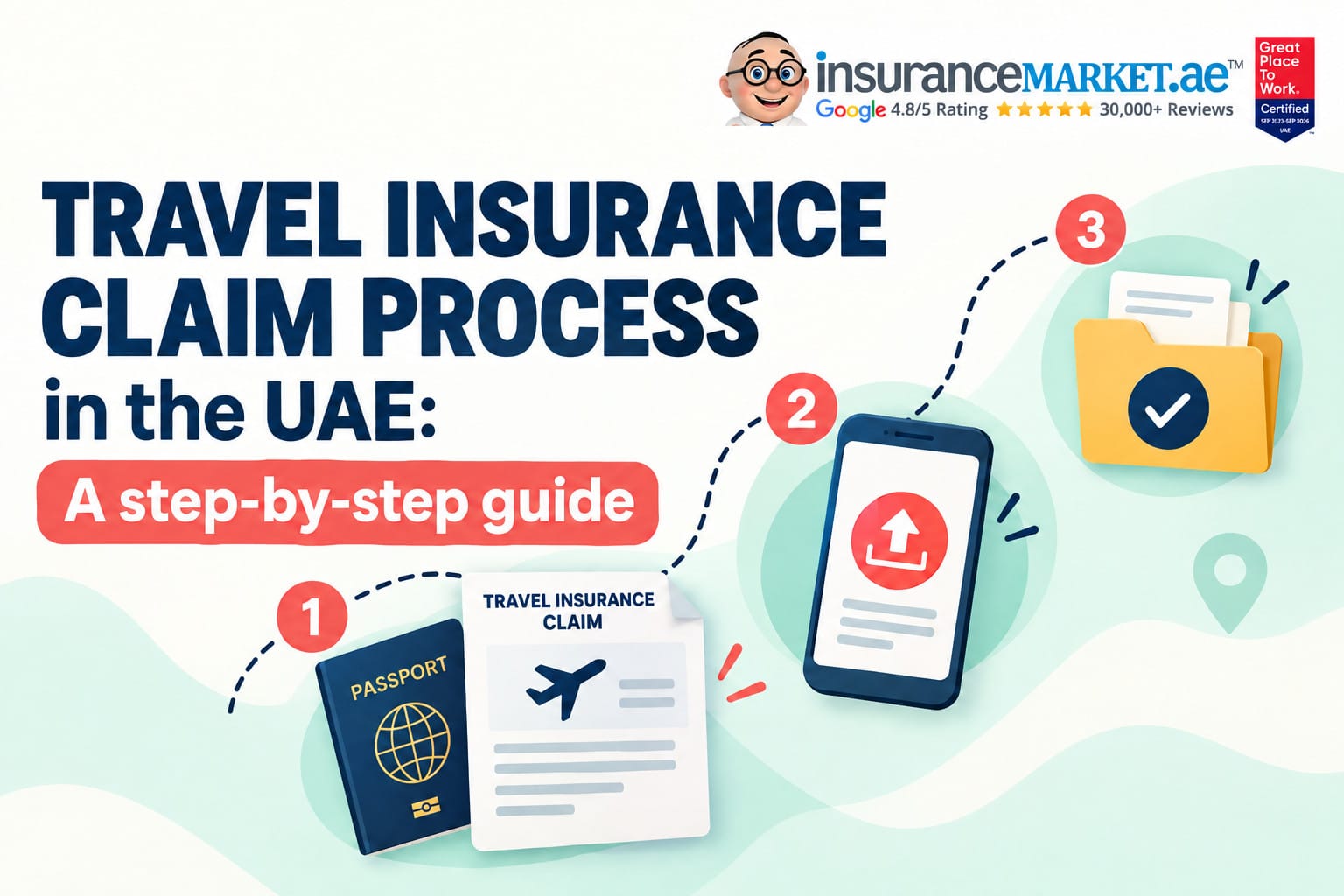
Travel Insurance Claim Process Step by Step
Each insurer has its own forms and submission channels, but the travel insurance claim process in the UAE usually follows these steps:
Step 1: Get Help and Stay Safe
In an emergency abroad, seek immediate medical help if needed. For theft, assault, or accidents, contact local authorities, such as the police, as soon as possible. Your health and safety come first, so don’t delay treatment in a serious situation.
Step 2: Notify the Insurer or Assistance Provider
As soon as it’s safe and practical, call the 24/7 emergency assistance number printed on your policy or e-card. If the matter is not urgent, such as a baggage delay, email or contact the claims or assistance team through the channel stated in your policy.
Provide your full name, policy number, location, contact details, and a brief summary of what happened. Ask what the best next step is, whether cashless treatment is possible at a network hospital, and what documents they will need for your travel insurance claim later.
This early contact matters. Many insurers in the UAE require prompt notification, especially for hospital stays or high costs.
Step 3: Follow Insurer Guidance During the Trip
Based on your call, the insurer may direct you to a network hospital or clinic for better coverage or cashless treatment, ask the hospital to submit a pre-authorisation form for planned or extended treatment, or confirm whether you should pay first and claim reimbursement later.
Keep a record of any reference numbers they give you, along with names, times, and communication channels.
Step 4: Collect All Supporting Documents
While still abroad, or as close to the incident as possible, collect medical reports, discharge summaries, itemised bills, police reports for theft or accidents, and boarding passes, delay letters, airline emails, or SMS messages for flight-related issues.
Keep all original receipts for accommodation, meals if delay cover applies, taxis to hospitals, replacement essentials, etc. These documents form the base of a strong travel insurance claim.
Step 5: Complete the Claim Form
After you return to the UAE, or sometimes while you are still abroad, download the claim form from your insurer’s website or customer portal, or request it by email. Select the correct claim type, such as medical, baggage loss or delay, trip cancellation or curtailment, travel delay, or personal liability.
Fill in all sections clearly and truthfully, including policy and personal details, trip information, incident details, and the amounts you are claiming. Attach copies of all supporting documents and keep the originals safely stored.
Step 6: Submit Your Claim
Submit the claim through the channel specified by your insurer. This may be an online portal upload, an email to the dedicated claims address, or physical submission, which is less common now but still used by some insurers.
Respect the time limit for claims, such as within 30, 60, or 90 days, and include your IBAN or bank details if reimbursement will be paid by bank transfer. You should receive a claim reference number, so note it down.
Step 7: Respond to Any Follow-Up Requests
The insurer’s claims team may ask for additional documents, clarifications, or original receipts, especially for large amounts. Respond promptly and completely to avoid delays.
Step 8: Claim Assessment and Settlement
After assessment, the insurer will approve the claim in full, approve it partially and explain any deductions, or reject it with a stated reason. If approved, payment is usually made by bank transfer to your UAE account or by cheque, depending on the insurer.
Documents Commonly Required for Any Claim
Exact requirements vary by claim type, but most travel insurance claim files include basic documents such as a passport copy, Emirates ID copy for UAE residents, the travel insurance policy or e-card, and boarding passes or e-tickets. Entry or exit stamps may also be requested.
For Medical Claims
For medical claims, insurers usually ask for medical reports or doctor’s notes with diagnosis, hospital admission and discharge summaries, itemised hospital and pharmacy bills, prescriptions for medication, and proof of payment, such as receipts, card slips, or bank statements if needed.
For Baggage Loss or Damage
For baggage loss or damage, you will usually need the Property Irregularity Report (PIR) from the airline, airline confirmation of loss or compensation received, a list of lost items and approximate values, and purchase receipts if available, especially for high-value items.
For Trip Cancellation or Curtailment
For trip cancellation or curtailment, prepare proof of non-refundable bookings, such as flights, hotels, and tours. You may also need evidence of the reason for cancellation, such as medical certificates if cancellation is due to illness, a death certificate or official notice for bereavement, or an employer letter if the cancellation is work-related and covered.
For Theft or Assault
For theft or assault, file a police report as soon as possible after the event and include a description of the incident and stolen items.
Providing all relevant documents at the start usually makes the travel insurance claim process smoother and faster.
How Long Does a Travel Insurance Claim Take?
Time frames differ by insurer and by the complexity of the case, but for anyone trying to claim travel insurance in the UAE market, the rough timelines are:
- Simple claims, such as small medical bills, minor delays, or baggage issues, are often processed within 7-15 working days after all documents are received.
- More complex claims, such as major medical cases, large cancellations, or multi-incident cases, may take 3-6 weeks or longer, especially if additional information is needed from hospitals abroad or there are discrepancies in the documents.
Two factors can speed things up: submitting a complete claim file the first time and responding quickly to any queries from the claims team.
If a claim seems delayed, contact the insurer using your claim reference number and ask whether any documents are missing or still under review.
Why Travel Insurance Claims Are Reduced or Rejected
Understanding why claims are sometimes paid partially, or not paid at all, can help you avoid unpleasant surprises. Common reasons include:
1. Claim Not Covered Under the Policy
Examples:
· Trying to claim for a pre-existing condition that is clearly excluded.
· Trip cancellations for reasons not listed as covered, such as a change of mind.
· Non-emergency or purely elective medical treatment, such as cosmetic treatment.
2. Exceeding Limits or Sub-Limits
Your claim could be reduced if the amount claimed is higher than your coverage limit for that section. Single-item limits for baggage or electronics are lower than the value claimed and the insurer pays only up to the maximum limit shown in your policy.
3. Missing or Insufficient Documentation
Typical problems include no medical report explaining the diagnosis and treatment, no police report for theft or loss when one is required, no PIR or airline confirmation for baggage issues, and no receipts or invoices for expenses claimed. Without evidence, insurers cannot validate the travel insurance claim.
4. Late Notification or Late Claim Submission
Issues here include not informing the insurer or assistance provider within the prescribed time frame during an emergency, submitting a claim well after the deadline stated in the policy. Insurers can reduce or decline claims if you don’t follow these obligations, especially if the delay affects their ability to verify facts.
5. Policy Conditions Not Followed
Examples:
· Receiving treatment at a non-recommended facility when the insurer required a specific network and you did not contact them first, where reasonably possible.
· Participating in excluded high-risk activities without the necessary add-ons.
· Alcohol or drug involvement where explicitly excluded.
6. Double Compensation Limitations
If you’ve already received full compensation from another party, such as an airline, the insurer may reduce or decline payment for the same loss, or pay only the difference if your loss exceeds what you already received.
This prevents double compensation and is standard across most travel insurance claim processes.
FAQ
1. How do I make a travel insurance claim in the UAE?
2. Who should I contact first during an emergency abroad?
3. Can I submit a claim after returning to the UAE?
4. Do I need original receipts?
5. Can I claim without a police report?
6. Can I claim from both the airline and insurer?
Conclusion
A successful travel insurance claim process in the UAE depends more on preparation and attention to detail than on luck.
To improve your chances of a smooth, fair outcome, understand your cover before you travel. In an emergency, get help first, then notify your insurer quickly. Collect thorough documentation, keep all receipts and reports, and submit your travel insurance claim clearly, honestly, and within the policy deadlines.
Handled this way, your travel insurance can do what it is meant to do: protect your health, your plans, and your finances, so you can focus on recovering from the disruption and getting back to your life.