Introduction
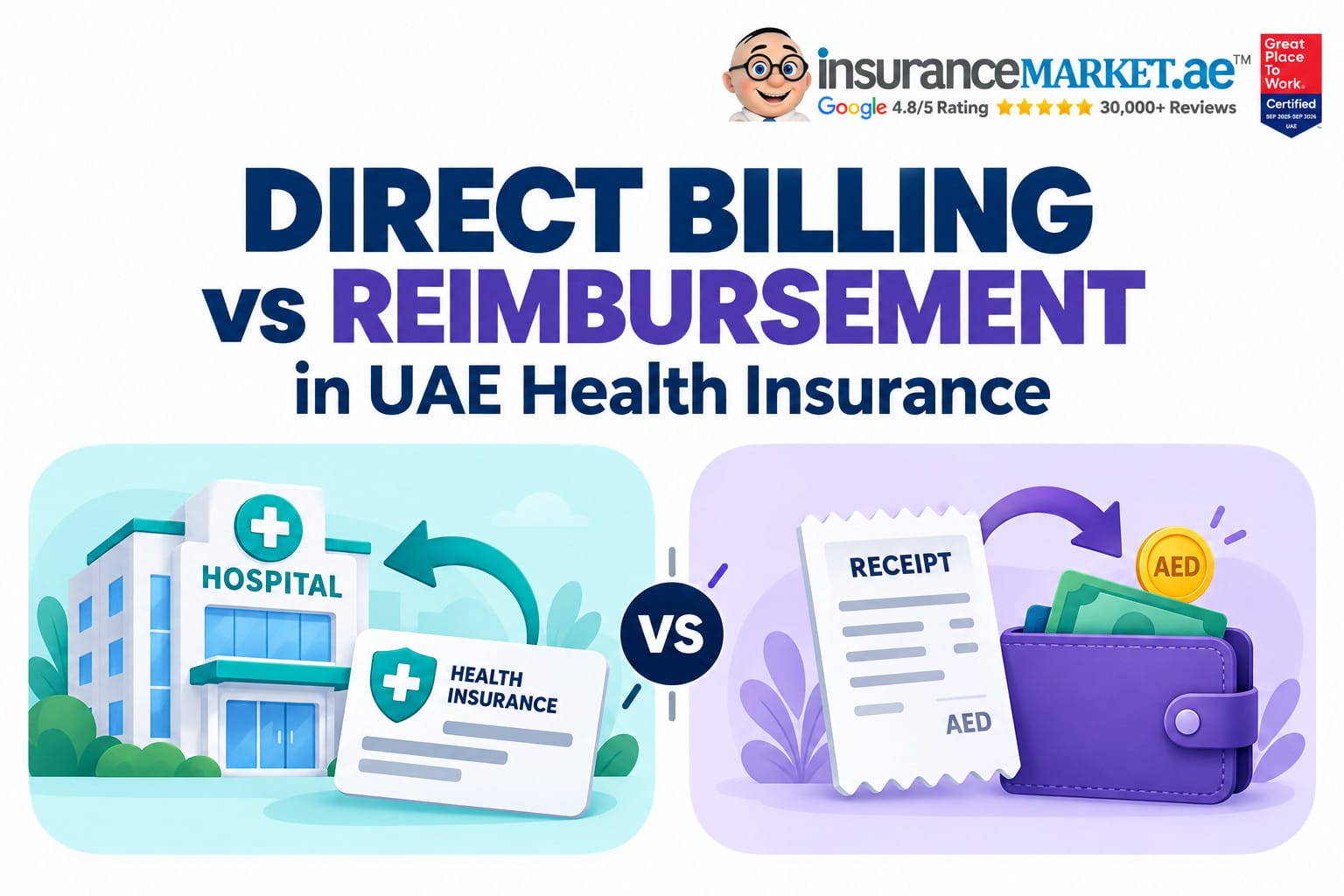
In the UAE, most people only really meet their health insurance when they are sitting in a clinic or hospital. That’s when two important concepts appear on the bill: direct billing and reimbursement.
Understanding the difference can help you use your cover correctly, avoid surprise out‑of‑pocket costs, and choose the type of plan that fits your lifestyle.
Direct Billing vs Reimbursement at a Glance
| Feature | Direct Billing / Cashless Treatment | Medical Reimbursement |
| Who pays the hospital initially? | Insurer/TPA (directly to the provider) | You (patient) pay the full bill first |
| What do you pay at the counter? | Only co‑pay + non‑covered items | Entire bill amount |
| Cash needed at time of service | Lower (only your share and exclusions) | Higher (full amount needed upfront) |
| Claim process timing | Mostly handled before/during treatment by provider & TPA | Done after treatment by you |
| Your role in paperwork | Minimal; provider coordinates with insurer/TPA | High; you collect documents and submit claim yourself |
| When do you get money back? | Not applicable (you don’t pay the full bill) | After claim approval (insurer reimburses eligible expenses) |
| Risk of claim rejection impact | If rejected, you may have to pay more at the hospital | If rejected/partially approved, you bear that cost yourself |
| Typical use case | Network hospitals with tie‑ups for cashless treatment | Non‑network hospitals or when cashless option is not used/available |
What Is Direct Billing in UAE Health Insurance?
Direct billing is the standard model for care at in‑network hospitals, clinics and pharmacies and here is how it works in practice:
- Visit a network provider.
- Present your insurance card and Emirates ID.
- The provider checks eligibility with your insurer/TPA system.
- If the service is covered, the clinic/hospital treats you, sends the bill to the insurer, and collects only your share (co‑pay/exclusions) from you.
You don’t need to fill out claim forms or wait for money back; most of the “behind‑the‑scenes” work happens between the provider and the insurer.
What Is Reimbursement in UAE Health Insurance?
Medical reimbursement comes in when direct billing isn’t possible or allowed under your policy, here are a few examples for you to refer:
- Use a non‑network hospital or clinic,
- Get treatment abroad where there is no direct‑billing arrangement,
- There’s a system outage and the provider cannot verify your coverage.
Below are a few recommendations to tackle such situations
- Pay the full amount yourself.
- Collect invoices, receipts, medical reports and prescriptions.
- Submit a reimbursement claim to your insurer/TPA.
- If approved, the insurer pays you back the eligible portion after co‑pays, limits and exclusions.
Reimbursement gives you more freedom to choose providers, but needs more admin and cash flow from your side.
Can One Health Insurance Plan Offer Both?
In the UAE most plans combine direct billing for in‑network providers in your area of cover; and reimbursement for the following scenarios
- Eligible out‑of‑network treatment
- Emergencies abroad
- Some pharmacy or dental claims (depending on the plan).
In such cases your health insurance policy wording will spell out exactly when each model applies.
Advantages and Limitations of Direct Billing
Here are a few advantages of direct billing
- Convenience – It is not needed to pay large sums and chase refunds.
- Predictability – Mainly deal with known co‑pays and small extras.
- Less paperwork – The provider handles most of the approvals and claim submissions.
While direct billing may be convenient the limitations of it are as follows
- Network only – It generally works only at providers within your approved network and sometimes only within your network tier.
- Pre‑authorisation – High‑cost procedures, admissions and some tests need prior approval. If that’s denied, direct billing is declined.
- Not all items are covered – Even at network providers you may need to pay for excluded or upgraded services in full.
Why Reimbursement May Be Lower Than the Medical Bill
It’s common for the reimbursed amount to be less than what you paid. Main reasons:
1. Co‑pays and deductibles
If your outpatient co‑pay is 20%, the insurer will refund only 80% of eligible expenses.
2. Benefit limits and sub‑limits
If you exceed limits e.g., annual medicine cap, physio session limits, anything above that is your responsibility.
3. Non‑covered services
Cosmetic procedures, non‑formulary drugs, extra scans or “check‑ups” outside your plan may be fully excluded.
4. Out‑of‑network pricing rules
Some policies reimburse out‑of‑network care only up to what the insurer would have paid in‑network. If you choose a very expensive non‑network hospital, you may receive back only a portion of the bill.
Understanding your schedule of benefits and exclusions is key to predicting how much you’ll actually get back.
Which Is Better?
Neither model is universally “better”, both can work well depending on your needs. If you’re receiving care within the UAE and are comfortable using your insurer’s network of partner hospitals and clinics, a plan with a strong direct-billing network is often more convenient and cost-effective.
If you travel frequently, prefer the freedom to see out-of-network specialists, or live in an area where network providers are limited, strong reimbursement benefits become more important.
In practice, the ideal plan is one that gives you good direct-billing coverage where you live and work, while also offering clear and reasonable reimbursement options for emergencies or situations where network care isn’t suitable.
When comparing policies, don’t just ask, “Do you offer direct billing?” It’s also important to ask where reimbursement is available, what percentage or rate is covered, and what documentation you’ll need to submit.
FAQ
1. Is direct billing the same as cashless treatment?
2. Do I still pay a co-pay with direct billing?
3. Can I visit any hospital under direct billing?
4. Can a plan include both direct billing and reimbursement?
5. Is out-of-network treatment always reimbursed?
6. How long does a reimbursement claim take?
7. What happens if direct billing is declined?
In that case you should ask for the reason in writing, contact your HR or broker for help interpreting the decision and exploring options or appeals.
Conclusion
Direct billing and reimbursement are two different ways your health insurance in the UAE can settle your medical bills.
- Direct billing gives you smooth, cashless access within network hospitals and clinics.
- Reimbursement gives flexibility outside the network, but requires more cash flow and paperwork, and is limited by policy rules.
The right balance depends on where you live, how you use healthcare and how much financial flexibility you have.
If you’re comparing plans and find the small print on direct billing and medical reimbursement confusing, the expert health insurance advisory team at InsuranceMarket.ae can walk you through the details and help you pick a policy that fits the way you actually live and seek care in the UAE.